
IBM Maximo - Create Asset
IBM Maximo - Create Asset creates an IBM Maximo asset for each of the devices returned by the selected query or assets selected on the relevant asset page, by mapping Axonius fields to Maximo asset attributes.
See Creating Enforcement Sets to learn more about adding Enforcement Actions to Enforcement Sets.
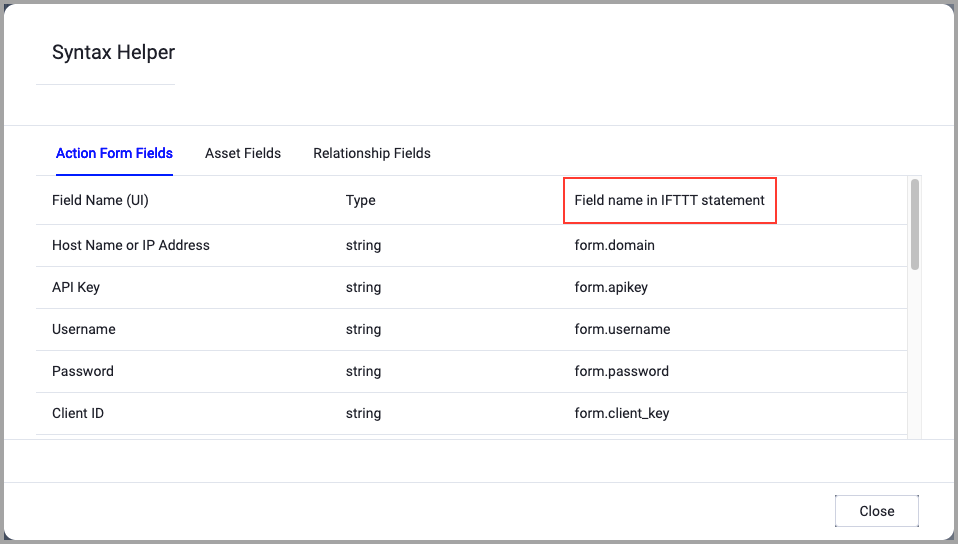
When accessing an enforcement action using the API, you must use the backend form of field names.
Use the Syntax Helper to find the correct name. In the enforcement action, enable Configure Dynamic Values and select Syntax Helper.
Note
- Not all asset types are supported for all Enforcement Actions.
- See Actions supported for Activity Logs, Adapters Fetch History, and Asset Investigation modules.
- See Actions supported for Aggregated Security Findings.
- See Actions supported for Software.
Required Fields
These fields must be configured to run the Enforcement Action.
- Action name - The name of this Enforcement Action. The system sets a default name. You can change the name.
- Configure Dynamic Values (optional) - Toggle on to enter a Dynamic Value statement. See Creating Enforcement Action Dynamic Value Statements to learn more about Dynamic Value statement syntax.
- Use stored credentials from the IBM Maximo adapter - Select this option to use credentials from the adapter connection. By default, the first connection is selected.
-
When you select this option, the Select Adapter Connection drop-down becomes available. Select the adapter connection to use for this Enforcement Action.
-
Note
If you do not select the Use stored credentials from the IBM Maximo adapter option, you must provide the connection parameters below.
-
Compute Node - The Axonius node to use when connecting to the specified host. For more details, see Working with Axonius Compute Nodes.
-
Site ID - The Maximo site to create the asset in. Axonius writes this value to the
siteidattribute. -
Map Axonius fields to Maximo asset attributes - Use the Map Fields component to define how Axonius data is sent to IBM Maximo. Each row maps a Maximo attribute (the target attribute of the Maximo asset) to an Axonius field (the source data from Axonius, or a static value entered directly).
- You can select one of these Maximo attributes:
assetnum,description,serialnum,assettype,status,location,manufacturer,vendor,itemnum,parent, andinstalldate. - You can also enter a custom attribute name, for example
tsys_hostname, in lowercase, as theMXASSETobject structure shows it. Axonius changes each attribute name to lowercase.
For details, see Axonius to External Field Mapping.
- The map must set
assetnum.
- You can select one of these Maximo attributes:
Additional Fields
These fields are optional.
- Organization ID - The Maximo organization to create the asset in. Axonius writes this value to the
orgidattribute.
Connection and CredentialsWhen Use stored credentials from the adapter is toggled off, some of the connection fields below are required to create the connection, while other fields are optional.
- Host Name or IP Address - The host name or IP address of the IBM Maximo server that Axonius can communicate with via the Required Ports.
- API Key - An API key of a user account that has the Required Permissions. Use either API Key, or User Name and Password.
- User Name and Password - The credentials of a user account that has the Required Permissions. Use either User Name and Password, or API Key.
Verify SSL (Optional) (default: enabled) - Selects whether to verify the SSL certificate of the server against the CA database inside of Axonius. For more details, see SSL Trust & CA Settings. This setting is enabled by default on all new adapter settings. If you need to disable SSL verification, make sure you disable this setting.)
HTTPS Proxy (optional) - Connect the adapter to a proxy instead of directly connecting it to the domain.
HTTPS Proxy User Name (optional) - The user name to use when connecting to the server using the HTTPS Proxy.
HTTPS Proxy Password (optional) - The password to use when connecting to the server using the HTTPS Proxy.
Gateway Name - Select the Gateway through which to connect to perform the action.
Note
- The action needs
assetnum(from the map) andsiteid(from Site ID).- The action fails for a device that already has an IBM Maximo asset from the selected connection. An asset from a different Maximo connection does not stop the creation.
- A failure on one device does not stop the other devices.
Example: A query finds Windows servers that are not in IBM Maximo. An Enforcement Set runs IBM Maximo - Create Asset with Site ID set to SITE1. The map sends the Axonius host name to assetnum and the serial number to serialnum.
Results
The Enforcement Set run page shows one result for each device:
- Success -
EC Action ibm_maximo_create_asset ran Successfully on entity <asset id> - Failure -
Failed to run EC Action on entity <asset id> <reason>. The reason is the HTTP error from IBM Maximo, or one of these:Missing required Maximo attribute(s) <list>: map them in "Map Axonius fields to Maximo asset attributes" (assetnum) or set them in the action (Site ID)This device already has an IBM Maximo asset (asset number <n>); use Update Asset instead
APIs
Axonius uses the IBM Maximo REST APIs:
POST {domain}/api/os/mxasset(API Key mode) - Create the asset.POST {domain}/oslc/os/mxasset(Basic Auth mode) - Create the asset.
Required Ports
Axonius must be able to communicate with the value supplied in Host Name or IP Address via the following ports:
- TCP port 443
Required Permissions
The stored credentials, or those provided in Connection and Credentials, must have the following permission(s) to perform this Enforcement Action:
The IBM Maximo account that Axonius uses, either the user of the API Key or the User Name, must have the Insert permission on the MXASSET object structure. Check and grant these permissions in the security settings of the MXASSET object structure in IBM Maximo.
For more details about other enforcement actions available, see Action Library.
Updated 7 days ago