
Datadog
Datadog is a monitoring service for cloud-scale applications, providing monitoring of servers, databases, tools, and services.
Use Cases the Adapter Solves
- Monitor Infrastructure Security Posture: Inventory all Datadog-monitored hosts alongside their tags, OS, and platform data to correlate device coverage with your broader asset inventory and detect gaps.
- Govern User Access and MFA Compliance: Track Datadog user accounts — including MFA status, disabled state, and verification — to identify non-compliant accounts and enforce access policies.
- Audit Organizational Security Settings: Surface Datadog application settings such as IP allowlist status, domain allowlist configuration, governance controls, and sensitive data scanner settings to validate that organizational security policies are applied.
Asset Types Fetched
- Devices, Users, Software, SaaS Applications, Containers, Compute Images, Application Settings, Serverless Functions
Data Retrieved through the Adapter
Devices - fields such as: Hostname, IP Address, OS Name, Platform, Tags, Last Seen
Users - fields such as: Email, Display Name, Username, Status, Created At, Is User Suspended
Application Settings - fields such as: MFA Enabled, User Disabled, User Verified, Service Account
Serverless Functions - The adapter classifies AWS Lambda functions as Serverless Functions and fetches info such as function name (when available), Tag, the AWS cloud provider, and the raw Datadog record.
Before You Begin
Required Ports
- TCP port 443 (HTTPS)
Authentication Methods
API Key and Application Key pair.
APIs
Axonius uses the Datadog API. The following endpoints are called:
GET /api/v1/hosts— Fetch devices (hosts)GET /api/v1/users— Fetch usersGET /api/v2/governance/control— Fetch governance controls (Application Settings)GET /api/v2/identity_providers— Fetch identity providers (Application Settings)GET /api/v2/roles— Fetch roles (Application Settings)GET /api/v2/csm/ownership/settings— Fetch CSM ownership settings (Application Settings)GET /api/v2/domain_allowlist— Fetch domain allowlist settings (Application Settings)GET /api/v2/governance/config— Fetch governance configuration (Application Settings)GET /api/v2/governance/notification_settings— Fetch governance notification settings (Application Settings)GET /api/v2/governance/control/{detection_type}/notification_settings— Fetch per-detection-type notification settings (Application Settings)GET /api/v2/identity_providers/{idp_id}/users— Fetch identity provider users (Application Settings)GET /api/v2/ip_allowlist— Fetch IP allowlist settings (Application Settings)GET /api/v2/roles/{role_id}/permissions— Fetch role permissions (Application Settings)GET /api/v2/roles/{role_id}/users— Fetch role members (Application Settings)GET /api/v2/sensitive-data-scanner/config— Fetch sensitive data scanner configuration (Application Settings)GET /api/v2/users— Fetch user MFA and status settings (Application Settings)
Required Permissions
The value supplied in Application Key must be associated with a user account that has read access to hosts and to users.
The following permissions are required in the Application Key:
To fetch Devices and Users:
host_readuser_access_read
To fetch Application Settings (when Fetch Application Settings is enabled):
org_management— required for IP Allowlist, Domain Allowlist, Identity Providers, Roles, and Governance endpointsdata_scanner_read— required for Sensitive Data Scanner configuration
To add a Datadog API key, application key, or client token, navigate to Integration -> APIs, enter a name for your key or token, and click Create API key or Create Application Key or Create Client Token.
For more details, see Datadog - API and Application Keys.
Note
If you are receiving a 403 "missing scopes" error, attempt removing all Scope assignments from the Application Key and testing again.
Connecting the Adapter in Axonius
- Navigate to the Adapter Catalog, search for Datadog, and select the adapter.
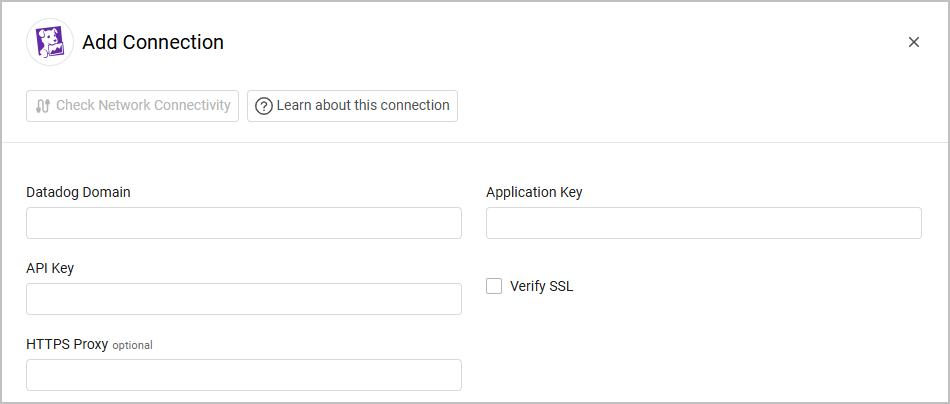
- Click Add Connection.
- Provide the following parameters.
Required Parameters
- Datadog Domain - The hostname or IP address of the Datadog server.
- Application Key and API Key - API and Application Keys associated with a user account that has the Required Permissions to fetch assets.
Note
You must generate the API and Application Keys from two locations in the Datadog admin console. In order for this to work, you need to pair both keys in the adapter wizard, as Datadog doesn't authenticate using only the Application Key — even with the scope of the key specified.
Optional Parameters
- Verify SSL - Verify the SSL certificate offered by the value supplied in Datadog Domain. For more details, see SSL Trust & CA Settings.
- HTTPS Proxy - A proxy to use when connecting to the value supplied in Datadog Domain.
To learn more about common adapter connection parameters and buttons, see Adding a New Adapter Connection.
Advanced Settings
Note
Advanced settings can either apply to all connections for this adapter, or to a specific connection. Refer to Advanced Configuration for Adapters.
- Fetch Network Devices Monitoring - Toggle on this option to fetch network devices.
- Fetch Network Devices Monitoring Interfaces - Select this option to fetch interfaces for each network device.
- Fetch Containers And Container Images (default: disabled) - Select to fetch these asset types.
- Fetch Application Settings (default: disabled) - Select to fetch Application Settings assets.
Note
To learn more about Adapter Configuration tab advanced settings, see Adapter Advanced Settings.
Related Enforcement Actions:
Updated 12 days ago