
Setting Threshold and Background Colors
Setting threshold colors is available for the following chart types:
- Query Intersection, including the Bar view
- Query Comparison
- Field Segmentation
- Field Summary, including the Gauge view
- Matrix Data Chart
- Pivot Chart, including the Gauge view
Setting the background color is available for the Pivot chart Summary widget.
Setting Threshold Colors
Configure visual color-codes to charts to easily identify the status of assets by setting asset count threshold colors. Set threshold colors allows you to set a color to indicate when the asset count exceeds a set threshold. Multiple threshold colors can be set to indicate different levels.
NoteWhen threshold colors are set, the colors for individual chart segments are disabled. Threshold colors also take priority over value colors and consistent value colors. See Setting Value Colors.
For example, you can set thresholds for asset counts of 10, 25, and 50. When each threshold is met or exceeded, the appropriate color is applied to the chart. Asset counts are set as fixed numbers for most chart types.
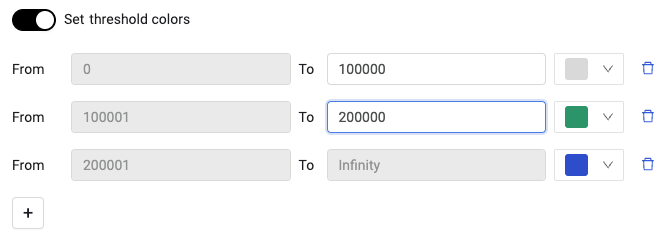
The chart is updated with the configured threshold and color selections.

For pie charts, thresholds are expressed as a percentage. When the returned asset count meets or exceeds a set threshold, the configured color is applied to the chart.
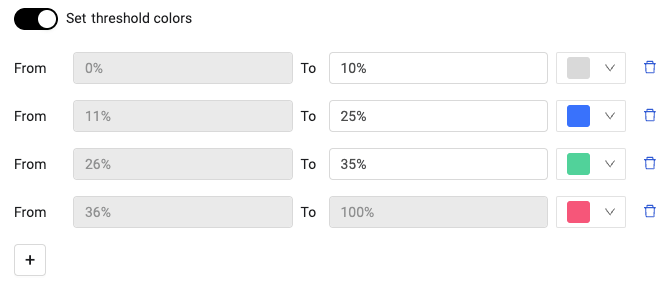
The chart is updated with the configured threshold and color selections.
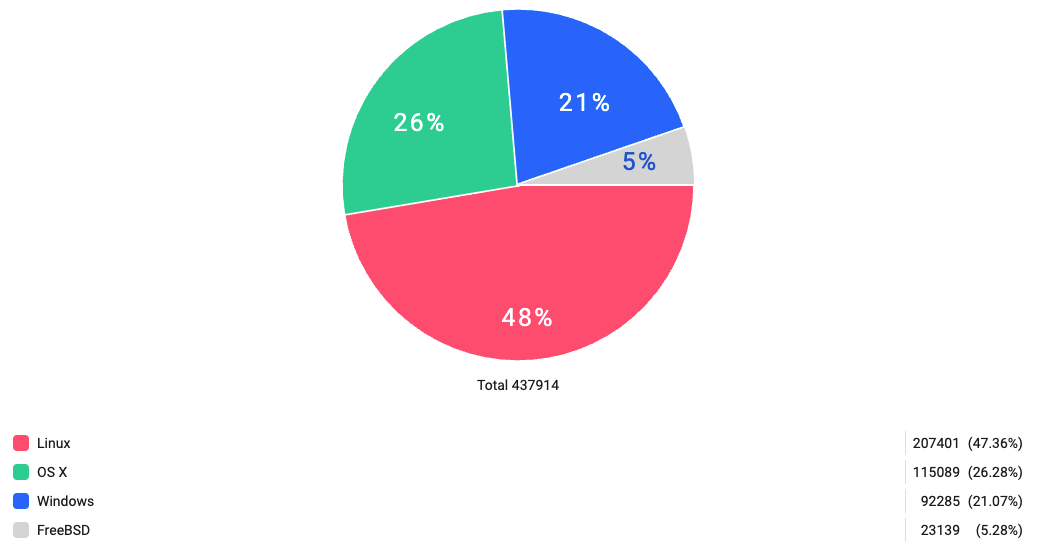
To set threshold colors:
- Toggle on Set threshold colors.
- Do one of the following:
- For all chart types, except for pie charts, enter a To value. If there is another threshold, the From value is automatically set to be one more than the To value in the previous threshold level. Then, in the color palette select a threshold color.
- For pie charts, enter a percentage value in the To field. If there is another threshold, the From value is automatically set to be one more than the To value in the previous threshold level. Then, in the color palette select a threshold color.
- To add a threshold level, click
+and enter the appropriate values.
Using Static and Dynamic Thresholds in Tables
Use static or dynamic thresholds to color the table view of the Field Segmentation, Query Comparison, and Matrix Data charts.
Permissions: To add a chart, you need the Dashboards > Charts > Add permission. To edit a chart, you need the Dashboards > Charts > Edit permission.
To set static or dynamic thresholds in a table:
- Add a Field Segmentation, Query Comparison, or Matrix Data chart, or edit one.
- In Visualization, select the table view.
- In Presentation, enable Set threshold colors.
- Select Static or Dynamic.
- For Static, set the From and To values and a color for each range. To add a range, click Add New Item.
- For Dynamic, in Set value gaps and color, enter a number and select a color.
- Click Save.
- Static is selected when you enable Set threshold colors. A cell, or a row, gets the color of the range that contains its value.
- Dynamic shades from white, for the lowest values, to the selected color, for the largest value in the table. The color list for Dynamic has only the preset colors.
- Static ranges in these tables can use any color. A chart can have up to 10 ranges.
- In Field Segmentation and Query Comparison tables, the shading is for each row. The Total row doesn't get a color.
- In a Matrix Data table, the colors apply to the count cells only. The thresholds work with any number of intersecting queries. The stacked view has only Static, and still needs one intersecting query.
- The other views of these charts, for example bar or pie, keep the threshold options that they had.
- In the Query Intersection Bar view, the thresholds use the Value type, Quantity or Percentage. See Bar Chart.
- In the Gauge view, the arc and the value use the color of the range that contains the value. See Using the Gauge View.
Example: A Field Segmentation table shows devices by OS type. Enable Set threshold colors, select Dynamic, and select red. The rows with the most devices are dark red, and the rows with few devices are almost white.
Applying Background Color to Pivot Summary Charts
Use background color on Pivot Summary charts to emphasize KPI values. Apply a single background color to highlight the metric, or use threshold colors to automatically change the background based on value ranges.
When you enable background color:
- The background color is applied to the KPI number area
- Text color automatically adjusts for readability
- If threshold colors are active, the background color changes based on the value and defined thresholds
To apply a static background color:
- In the Chart Wizard, create or edit a Pivot chart.
- In the Data section, select Summary as the chart view.
- Configure your data source, query, and measure.
- In the Presentation section, select a color for your measure (this becomes the background color).
- Enable Apply background color.
The KPI number displays with the selected background color.
To apply threshold-based background colors:
- In the Chart Wizard, create or edit a Pivot chart.
- In the Data section, select Summary as the chart view.
- Configure your data source, query, and measure.
- In the Presentation section, enable Threshold colors.
- Define your threshold ranges:
- Set the From and To values for each range.
- Select a color for each range.
- Click Add threshold color to add more ranges.
- Enable Apply background color.
The KPI number displays with a background color that matches the threshold range containing the current value.
NoteWhen threshold colors are active, the threshold color overrides the measure color for the background.
Updated 12 days ago