
Halo - Link Device to User
Halo - Link Device to User links a Halo device asset to a user account for:
- Assets returned by the selected query or assets selected on the relevant asset page.
See Creating Enforcement Sets to learn more about adding Enforcement Actions to Enforcement Sets.
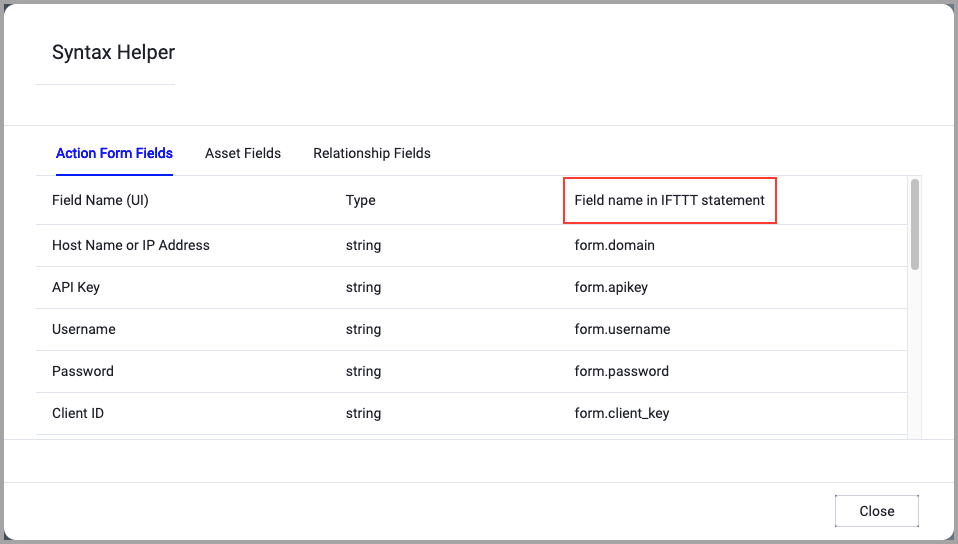
When accessing an enforcement action using the API, you must use the backend form of field names.
Use the Syntax Helper to find the correct name. In the enforcement action, enable Configure Dynamic Values and select Syntax Helper.
Note
- Not all asset types are supported for all Enforcement Actions.
- See Actions supported for Activity Logs, Adapters Fetch History, and Asset Investigation modules.
- See Actions supported for Aggregated Security Findings.
- See Actions supported for Software.
Required Fields
These fields must be configured to run the Enforcement Action.
- Action name - The name of this Enforcement Action. The system sets a default name. You can change the name.
- Configure Dynamic Values (optional) - Toggle on to enter a Dynamic Value statement. See Creating Enforcement Action Dynamic Value Statements to learn more about Dynamic Value statement syntax.
- Use stored credentials from the Halo adapter - Select this option to use credentials from the adapter connection. By default, the first connection is selected.
-
When you select this option, the Select Adapter Connection drop-down becomes available. Select the adapter connection to use for this Enforcement Action.
-
-
Compute Node - The Axonius node to use when connecting to the specified host. For more details, see Working with Axonius Compute Nodes.
- Halo User ID - Populated automatically via "Configure Dynamic Values" → Relation → Users → Latest last used user → Aggregated → Halo adapter → Halo ID.
NoteThis field is automatically populated using Configure Dynamic Values. Navigate to the device's related user, select the latest user, and map the Halo User ID field from the Halo adapter data.
Additional Fields
This Enforcement Action does not have additional optional fields.
Connection and CredentialsWhen Use stored credentials from the adapter is toggled off, some of the connection fields below are required to create the connection, while other fields are optional.
- Host Name or IP Address - Base domain for the Halo API, should contain a prefix of http:// or https://. Do not add any specific endpoints after the domain. Example of a valid domain:
https://www.halo.com/- Client ID - Client ID for OAuth authentication with the Halo API.
- Client Secret - Client Secret for OAuth authentication with the Halo API.
- Tenant - Tenant identifier (only used for Hosted Solution).
Verify SSL (Optional) (default: enabled) - Selects whether to verify the SSL certificate of the server against the CA database inside of Axonius. For more details, see SSL Trust & CA Settings. This setting is enabled by default on all new adapter settings. If you need to disable SSL verification, make sure you disable this setting.)
HTTPS Proxy (optional) - Connect the adapter to a proxy instead of directly connecting it to the domain.
HTTPS Proxy Password (optional) - The password to use when connecting to the server using the HTTPS Proxy.
HTTPS Proxy User Name (optional) - The user name to use when connecting to the server using the HTTPS Proxy.
Gateway Name - Select the Gateway through which to connect to perform the action.
APIs
Axonius uses the Halo API - POST /api/Asset
Required Ports
Axonius must be able to communicate via the following ports:
- TCP port 80/443
Required Permissions
The stored credentials, or those provided in Connection and Credentials, must have the following permission(s) to perform this Enforcement Action:
- A registered OAuth application in Halo with Client ID and Client Secret
- The API user must have permissions to update asset records and link users to assets
Note: The exact permission names should be confirmed with your Halo administrator or Halo support, as the API documentation is not publicly available.
To learn more about Enforcement Actions, see Enforcement Actions.
Version Matrix
This Enforcement Action was tested only with the versions marked as supported, but may work with other versions. Please contact Axonius Support if you have a version that is not listed and it is not functioning as expected.
| Version | Supported | Notes |
|---|---|---|
| Halo Service Desk (All Versions) | ✅ | Tested with Halo API |
| Halo ITSM | ✅ | Compatible with Halo API |
| Halo PSA | ✅ | Compatible with Halo API |
Updated 12 days ago