
Kenna Security Platform
Kenna Security Platform is a vulnerability assessment solution that provides risk scoring, prioritization, and benchmarking.
Use Cases the Adapter Solves
- Vulnerability Prioritization and Risk Reduction: Correlate Kenna-scored vulnerabilities with your asset inventory in Axonius to identify which devices carry the highest-risk open vulnerabilities, enabling security teams to focus remediation efforts where they matter most.
- Asset Inventory Enrichment: Combine Kenna's vulnerability and fix data with asset records from other adapters to produce a unified, enriched view of device risk posture across the organization.
- Compliance and Coverage Reporting: Use Axonius queries and dashboards to report on vulnerability coverage, severity distribution, and remediation progress across all assets sourced from Kenna.
Asset Types Fetched
- Devices, Aggregated Security Findings, Software, SaaS Applications, Domains & URLs
Before You Begin
Required Ports
- TCP port 443 (HTTPS)
APIs
Axonius uses the Kenna Security Platform REST API. The following endpoints are called:
GET /assets- List assets (used when Use export API is disabled; limited to 10,000 results)GET /vulnerabilities- List vulnerabilities (used when Use export API is disabled; limited to 10,000 results)GET /fixes- List fixes (used when Use export API is disabled)POST /data_exports- Request a data export (used when Use export API is enabled; supports more than 10,000 assets)GET /data_exports/{id}- Retrieve data export results
For full API reference, see Kenna Security Platform API Docs.
Required Permissions
The following permissions are required:
Administrator Role (Recommended)
- Full API access to all endpoints, including data exports, without requiring explicit asset-level Can View permissions.
Read-Only User Role (Minimum)
- API access is granted by an administrator from Settings > API Keys.
- The user must be assigned the Read-Only User role to obtain read-only API access.
- For users with custom roles, the following API endpoint permissions are required:
- List Assets
- Search Assets
- List Vulnerabilities
- Search Vulnerabilities
- Show Vulnerability
- List Fixes
- Show All Fixes
- Request Data Export
- Retrieve Data Export
- Check Data Export Status
Connecting the Adapter in Axonius
- Navigate to the Adapter Catalog, search for Kenna Security Platform, and select the adapter.
- Click Add Connection.
- Provide the following parameters.
Required Parameters
- Kenna Security Platform URL (default:
https://api.kennasecurity.com) - The URL for the Kenna Security Platform admin panel. This may be the default domain or a company-specific URL (e.g.,https://mycompany.kennasecurity.com). For EU instances, usehttps://api.eu.kennasecurity.com. - API Token - Specify your account API key or an API token you have created. To locate your token, follow the instructions in API Key Generation and Permissions.
- Verify SSL (default: enabled) - Select whether to verify the SSL certificate of the server against the CA database inside of Axonius. For more details, see SSL Trust & CA Settings.
- Wait for export results (seconds) -
- Multiply wait time per retry factor -
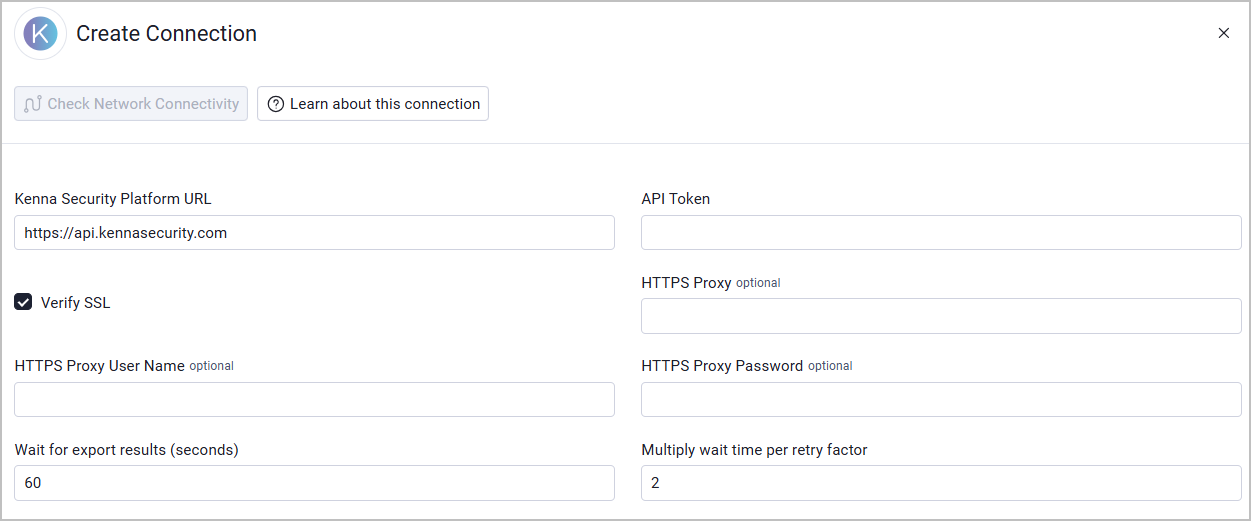
Optional Parameters
- HTTPS Proxy - Connect the adapter to a proxy instead of directly connecting it to the domain.
- HTTPS Proxy User Name - The user name to use when connecting to the value supplied in Kenna Security Platform URL via the value supplied in HTTPS Proxy.
- HTTPS Proxy Password - The password to use when connecting to the server using the HTTPS Proxy.
To learn more about common adapter connection parameters and buttons, see Adding a New Adapter Connection.
Advanced Settings
Note:
Advanced settings can either apply to all connections for this adapter, or to a specific connection. Refer to Advanced Configuration for Adapters.
To learn more about Adapter Configuration tab advanced settings, see Adapter Advanced Settings.
- Use export API - Select whether to use the
data_exportendpoint. If enabled, all connections for this adapter will fetch data from thedata_exportendpoint, which supports fetching more than 10,000 assets. If disabled, all connections will fetch data from the assets, vulnerabilities, and fixes endpoints, which are limited to 10,000 results. - Export full data (default: false) - Select this option to fetch additional vulnerability date fields from Kenna for use in charts. Requires Use export API to be enabled.
- Fetch device vulnerabilities and fixes - Select whether to fetch vulnerability and fix information for devices. If disabled, only device information is fetched.
- Skip fixes when fetching vulnerabilities - Select whether to skip fix data when fetching vulnerabilities. Requires Fetch device vulnerabilities and fixes to be enabled.
- Do not fetch devices with no MAC address, no hostname and no NetBIOS - Select whether to exclude fetching devices that have no MAC address, no hostname, and no NetBIOS.
- Do not fetch devices with no MAC address and no hostname - Select whether to exclude fetching devices that have no MAC address and no hostname.
- Do not ingest heavy fields - Select this option to skip parsing the "Open Ports Vulnerabilities: Vulnerability Solution" field.
- Severity level to fetch - Select which severity level to fetch, from 1 to 10.
- Parse URL assets as Domain & URL entities - Select this option to parse Kenna URL assets as Domain & URLs rather than Devices. Data fetched for URLs includes Name, Domain, Base URL, Remote ID, Risk Meter Score, Status, External ID, and Asset Tags.
- Fetch CVE Enrichments from Kenna VI+ - Select to enrich Vulnerability Instances with data from Kenna Vulnerability Intelligence+.
Related Enforcement Actions
Updated 2 days ago
Did this page help you?