
Cisco
Cisco connects to Cisco switches and routers. A separate connection entry is required for each switch that is being queried.
Note
The Cisco adapter supports Cisco Routers, Switches and Wireless Controllers leveraging IOS (Internetwork Operating System), and IOS-XE.
Asset Types Fetched
- Devices, Network/Firewall Rules (via Advanced Settings)
Selecting the Protocol to Use
The Cisco adapter supports multiple connection protocols. You must choose ONE protocol per connection. Different protocols fetch different types of data and have different requirements.
The Cisco adapter provides the following protocol options in the Protocol dropdown:
- SNMP (SNMPv1) — Default, recommended for best performance
- SNMPv2 (SNMPv2c)
- SNMPv3
- SNMPv3 with Fallback
- SSH
- Telnet
Select the tab of the protocol you are considering to see when to use it, what it fetches, what it requires, and how it compares to the other protocols.
Recommended for: Network infrastructure discovery, switch port mapping, and best performance
Use SNMP (Recommended) when:
- You need comprehensive network topology and switch port data
- You want best performance and lowest resource impact
- You need to discover devices connected to switch ports (via MAC tables)
- You are performing network infrastructure discovery
Use SNMPv3 when:
- You require encrypted SNMP communication
- Your security policy mandates authenticated and encrypted management protocols
What SNMP Fetches:
- Devices — Network devices (switches, routers, access points)
- Switch port information — Port status, VLANs, port security
- Network topology — CDP/LLDP neighbor data
- MAC address tables — Connected device MAC addresses
- ARP tables — IP-to-MAC mappings (when "Fetch ARP data" is enabled)
- Interface statistics — Port utilization, errors
- VLAN information — VLAN assignments and configurations
Requirements:
- Port: TCP 161 (SNMP)
- Credentials:
- SNMP/SNMPv2: SNMP Read Community string
- SNMPv3: Username, Authentication Passphrase, Privacy Passphrase, Security Level, Auth Protocol, Priv Protocol
Advantages:
- Fastest performance — Optimized for bulk data collection
- Best for network discovery — Fetches comprehensive switch port and topology data
- Lower resource impact — Minimal load on network devices
Limitations:
- Does not fetch detailed device configurations — Limited to SNMP MIB data
- May fetch fewer total devices — Focuses on network infrastructure rather than end devices
Recommended for: Detailed device configuration retrieval, Cisco IOS command execution
Use SSH when:
- You need detailed device configurations
- You want to execute custom Cisco IOS commands
- You need detailed hardware and software inventory
- SNMP is not available or restricted
What SSH Fetches:
- Devices — Network devices accessible via SSH
- Detailed device configurations — Running configurations, startup configurations
- Command output — Results from Cisco IOS commands (show commands)
- Software versions — Detailed IOS/firmware information
- Hardware inventory — Module and component details
Requirements:
- Port: TCP 22 (SSH)
- Credentials: Console username and password with appropriate privilege level
Advantages:
- May fetch more total devices — Can discover devices through command output (e.g.,
show cdp neighbors) - Detailed configuration data — Access to full device configurations
- Flexible command execution — Can run custom show commands
- Supports MAC table entries — Critical for discovering connected devices
Limitations:
- Slower performance — Sequential command execution takes longer than SNMP bulk queries
- Higher resource impact — SSH sessions consume more device resources
- Requires console access — Needs appropriate privilege level (typically privilege 15)
Recommended for: Legacy devices that do not support SSH
Use Telnet when:
- SSH is not available on legacy devices
- Only as a last resort due to security concerns
What Telnet Fetches:
- Similar to SSH (see the SSH tab)
Requirements:
- Port: TCP 23 (Telnet)
- Credentials: Console username and password
Security Warning:
- Unencrypted protocol — Credentials and data transmitted in clear text
- Use only when SSH is not available
Important Notes
- One Protocol Per Connection: Each connection uses only one protocol. You cannot combine protocols in a single connection.
- Different Data Sets: SNMP and SSH fetch different types of data. The same host configured with both protocols may return different device counts and data.
- Multiple Connections Recommended: For comprehensive coverage, create two separate connections to the same host:
- Connection 1: SNMP (for network topology and switch ports)
- Connection 2: SSH (for detailed configurations)
- Performance Considerations:
- SNMP is significantly faster for bulk network discovery
- SSH is slower but provides richer configuration data
Connecting the Adapter in Axonius
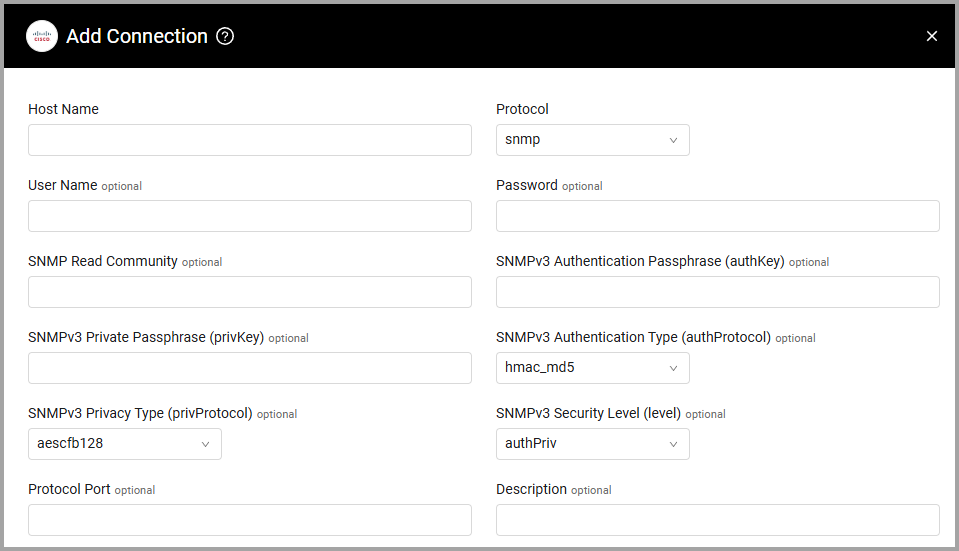
Navigate to the Adapters page, search for Cisco, and click on the adapter tile. Click Add Connection.
To connect the adapter in Axonius, provide the following parameters:
Required Parameters
- Host Name - The hostname or IP address of the Cisco server.
- Protocol (default: SNMP) - Select the desired protocol from the dropdown. The SNMP option refers to SNMPv2c. It is highly recommended to use SNMP for best network performance and to utilize the available adapter functionalities.
Optional Parameters
- User Name and Password (optional) - The user name and password for the switch, if required.
- SNMP Read Community - Specify the SNMP read community string, if using SNMP.
- SNMPv3 Authentication Passphrase (authKey) - Specify the user authentication key passphrase (authKey), if using SNMPv3.
- SNMPv3 Private Passphrase (privKey) - Select the user private key passphrase (privKey), if using SNMPv3.
- SNMPv3 Authentication Type (authProtocol) (default: hmac_md5) - Select the authentication type (authProtocol), if using SNMPv3.
- SNMPv3 Privacy Type (privProtocol) (default: aescfb128) - Select the privacy type (privProtocol), if using SNMPv3.
- SNMPv3 Security Level (level) (optional, default: authPriv) - Select the security level (level), if using SNMPv3.
- Protocol Port - Specify if the connection needs to be on a non-standard port.
- Description - Enter a description for the connection.
To learn more about common adapter connection parameters and buttons, see Adding a New Adapter Connection.
Advanced Settings
Note
Advanced settings can either apply to all connections for this adapter, or to a specific connection. Refer to Advanced Configuration for Adapters.
- Fetch ARP data (required, default: true) - Select to fetch ARP data from the Cisco server.
- SNMP timeout - Specify the number of seconds that SNMP requests should wait for a response before timing out. If left empty, the default value is 15 seconds.
- Create assets from connected devices - Select this option to fetch all connected devices with data from SNMP.
- Create assets from port security data - Select this option to add all connected devices from the port security entities as assets with the same fields as in Create assets from connected devices.
- Create assets from stacked switches - Select this option to fetch each switch in the switch stack as a separate device.
- Fetch Firewall Rules - Select to fetch firewall rules (ACL and NAT) as assets. The adapter collects firewall rules using two parallel methods:
-
SNMP Collection (when using SNMP protocols)
• caAclIPV4ACECfgTable (OID: 1.3.6.1.4.1.9.9.808.1.2) - IPv4 ACL entries
• caAclIPV6ACECfgTable (OID: 1.3.6.1.4.1.9.9.808.1.3) - IPv6 ACL entries
• natAddrBindTable (OID: 1.3.6.1.2.1.123.1.6) - NAT address bindings -
SSH Collection (when using SSH protocol)
• show access-lists - All ACL types with match counts
• show ip nat translations - Live NAT translation table
-
- Fetch Interfaces as Devices - Select this option to create a separate device asset per switch interface from SSH connections. Disable to suppress standalone interface assets; interface data is still used to enrich the switch device regardless of this setting.
- Enable Custom Parsing - Enable this option to define how to parse specific fields from the raw data fetched. You can choose to parse the data into an already existing field, or create a new one. See Adapter Custom Parsing for more information.
Note
For details on general advanced settings under the Adapter Configuration tab, see Adapter Advanced Settings.
Related Enforcement Actions
Updated 3 days ago