
Lenovo Device Orchestration
Lenovo Device Orchestration is a device management platform that provides AI-driven fleet health monitoring, hardware diagnostics, warranty tracking, and software update orchestration for Lenovo endpoints.
Use Cases the Adapter Solves
- Comprehensive Device Health Monitoring: Gain visibility into the health and diagnostic status of Lenovo devices across your fleet, including battery health, storage status, and overall device health scores for proactive maintenance
- Warranty and Lifecycle Management: Track warranty status and device lifecycle information to ensure timely renewals and replacements before coverage expires
Asset Types Fetched
- Devices
- Users
Data Retrieved through the Adapter
Devices
Users
Before You Begin
Required Ports
- TCP port 443 (HTTPS)
Authentication Methods
OAuth 2.0 Client Credentials Authentication
The adapter uses OAuth 2.0 client credentials flow for authentication. The adapter authenticates using a Client ID and Client Secret to obtain a Bearer token from the /ldi/api/v1/auth/{orgId}/token endpoint. The token is automatically refreshed every 29 minutes.
APIs
Axonius uses the Lenovo Device Orchestration (LDI) API. The following endpoints are called:
POST /ldi/api/v1/auth/{orgId}/token- Authenticates and retrieves an access tokenGET /dms/device-management/v2/devices- Retrieves device information including hardware details, health status, and diagnosticsGET /ldi/api/v1/devices-insights/{deviceId}/warranties- Retrieves warranty information for specific devicesGET /ldi/api/v1/ldiplus/users- Retrieves user information from the LDI platform
Required Permissions
The API user must have an Organization Admin account in Lenovo Device Orchestration with permission to generate API credentials.
Note: The exact permission names should be confirmed with your Lenovo Device Orchestration administrator or Lenovo support, as the API documentation is not publicly available.
Supported From Version
Supported from Axonius version 9.0.1
Connecting the Adapter in Axonius
Navigate to the Adapters page, search for Lenovo Device Orchestration, and click on the adapter tile.
Click Add Connection.
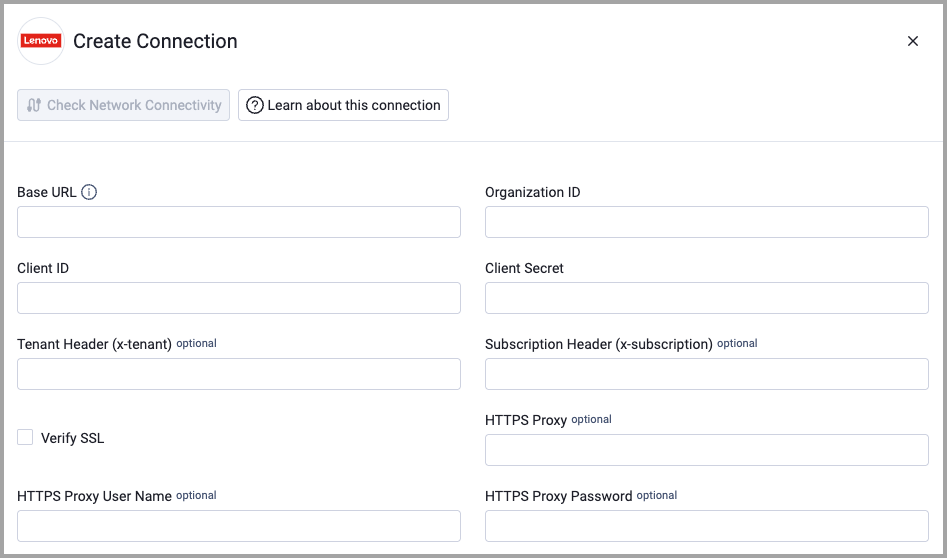
To connect the adapter in Axonius, provide the following parameters:
Required Parameters
- Base URL - Full base URL including /dms path. Example:
https://api.euwe1.uds.lenovo.com/dms - Organization ID - Your Lenovo Device Orchestration organization identifier
- Client ID - The API Client ID generated in Lenovo Device Orchestration
- Client Secret - The API Client Secret generated in Lenovo Device Orchestration
- Tenant Header (x-tenant) - Your Lenovo Device Orchestration tenant identifier.
- Subscription Header (x-subscription) - Your Lenovo Device Orchestration subscription identifier.
Optional Parameters
- Verify SSL - Select whether to verify the SSL certificate of the server against the CA database inside of Axonius. For more details, see SSL Trust & CA Settings.
- HTTPS Proxy - Connect the adapter to a proxy instead of directly connecting it to the domain.
- HTTPS Proxy User Name - The user name to use when connecting to the value supplied in Base URL via the value supplied in HTTPS Proxy.
- HTTPS Proxy Password - The password to use when connecting to the server using the HTTPS Proxy.
To learn more about common adapter connection parameters and buttons, see Adding a New Adapter Connection.
Updated about 2 months ago