
Nozomi Guardian and CMC
Nozomi Guardian and CMC (formerly Nozomi Networks Guardian) monitors network communications and device behavior for physical and virtual appliances.
Assets Types Fetched
- Devices, Aggregated Security Findings, SaaS Applications
Before You Begin
Required Ports
Axonius must be able to communicate with the value supplied in Guardian Appliance Domain via the following ports:
- TCP port 443: SOAP API
Required Permissions
You must connect the adapter with a user that has read access to devices. The credentials of the user performing the OpenAPI call to query data must be in a group that has the Queries and exports permission set. This allows the user to view the query section and to export data.
(708).png)
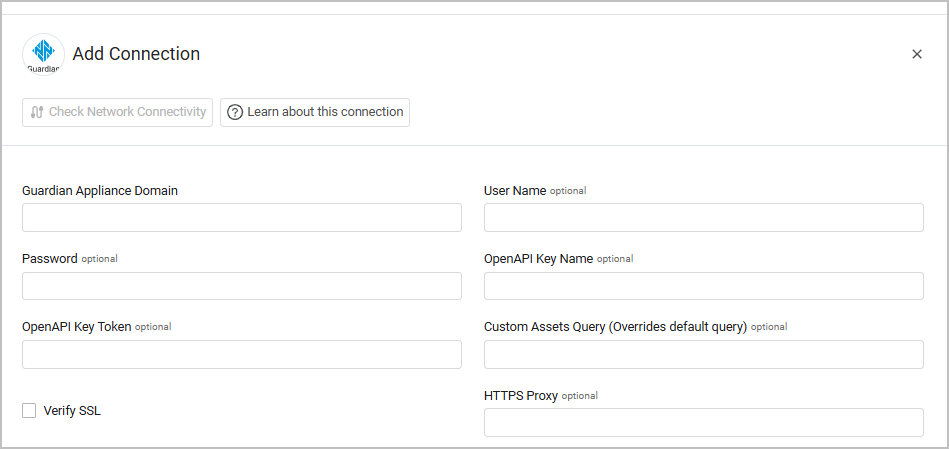
Connecting the Adapter
- Guardian Appliance Domain (required) - The Nozomi Networks Solution's web interface IP or domain that Axonius can communicate with via the Required Ports.
- User Name and Password (optional) - The credentials for a user account that has the Required Permissions to fetch assets.
Note
When OpenAPI Key Name and OpenAPI Key Token are not supplied, User Name and Password are required.
- OpenAPI Key Name and OpenAPI Key Token (optional) - This is an OpenAPI key associated with a user account that has the Required Permissions to fetch assets. See Chapters 3 and 5 in the N2OS User Manual for instructions on creating an OpenAPI key.
Note
When User Name and Password are not supplied, OpenAPI Key Name and OpenAPI Key Token are required.
-
Custom Assets Query (Overrides default query) (optional) - Provide a custom query to fetch specific assets, with the same syntax as in the Nozomi console. The query must refer to the "assets" table.
- Example custom query:
assets | where is_empty(os_or_firmware) == false | where type in? ["<confirmed_type_1>","<confirmed_type_2>",...] - If no custom query is supplied, the default query is "assets," which will fetch all assets.
- Example custom query:
-
Verify SSL - Select whether to verify the SSL certificate of the server against the CA database inside of Axonius. For more details, see SSL Trust & CA Settings.
-
HTTPS Proxy (optional) - Connect the adapter to a proxy instead of directly connecting it to the domain.
To learn more about common adapter connection parameters and buttons, see Adding a New Adapter Connection.
Advanced Settings
Note
Advanced settings can either apply for all connections for this adapter, or you can set different advanced settings and/or different scheduling for a specific connection, refer to Advanced Configuration for Adapters
- Do not populate hostnames and asset names with MAC addresses (optional, default: False) - When selected, hostnames and asset names of devices will remain empty if the source has a MAC address for the asset's name/hostname.
- Pagination page size - The number of devices to fetch in each request.
- Async chunks in parallel - The number of requests to run in parallel.
- Fetch devices vulnerabilities - Select this option to fetch vulnerabilities.
- Use last seen by - Select which field to use as the aggregated “Last Seen“ field, either "Time" (default) or "Last activity time".
- Skip Vulnerabilities below likelihood value - Enter a value so that the adapter won't fetch vulnerabilities that have a likelihood value below the set value.
- The default is 0, meaning all vulnerabilities will be fetched if Fetch devices vulnerabilities is also turned on.
- In order to enable Skip Vulnerabilities below likelihood value, Fetch devices vulnerabilities must not be selected.
- Ignore device if its name matches the appliance host - Select to ignore assets whose name matches the appliance host value.
- Parse vulnerabilities only for these device types (empty = parse for all) - Specify asset types for which you want to fetch vulnerabilities. Note that this setting is case sensitive - ensure exact match with device types reported by Nozomi Guardian.
- Example: If you want to focus on OT-specific network equipment and remote terminal units, excluding standard computers and servers, enter the following device types: "Industrial Router", "Industrial Switch", "RTU".
Note
To learn more about Adapter Configuration tab advanced settings, see Adapter Advanced Settings.
Updated 3 days ago