
Intrigue
Intrigue enables IT and Security teams with a complete and always up to date view of Cloud and Internet-exposed assets and exposures.
Use Cases the Adapter Solves
- Attack Surface Visibility: Continuously discover and monitor Cloud and Internet-exposed assets to maintain an accurate inventory of your organization's external attack surface.
- Exposure Prioritization: Identify unmanaged or unknown internet-facing devices with open ports and geolocation data to prioritize remediation efforts.
Asset Types Fetched
- Devices
Data Retrieved through the Adapter
Devices - fields such as: IP Address, Operating System, Net Name, Country
Before You Begin
Required Ports
- TCP port 443 (HTTPS)
Authentication Methods
The Intrigue adapter authenticates using an Access Key and Secret Key.
APIs
Axonius uses the Intrigue.io API. The following endpoints are called:
GET /api/collections/{collection_name}/hosts- Fetch all hosts (devices) in the specified collection
Required Permissions
The values supplied in Access API Key and Secret API Key must have read access to devices. To generate Access API Key and Secret API Key, login to Intrigue, browse to your profile, and select Generate Token under the API Access section.
Connecting the Adapter in Axonius
- Navigate to the Adapter Catalog, search for Intrigue, and select the adapter.
- Click Add Connection.
- Provide the following parameters.
Required Parameters
- Collection Name - The Intrigue collection name. Example:
my-collection - Access API Key - The Access Key associated with your Intrigue account.
- Secret API Key - The Secret Key associated with your Intrigue account.
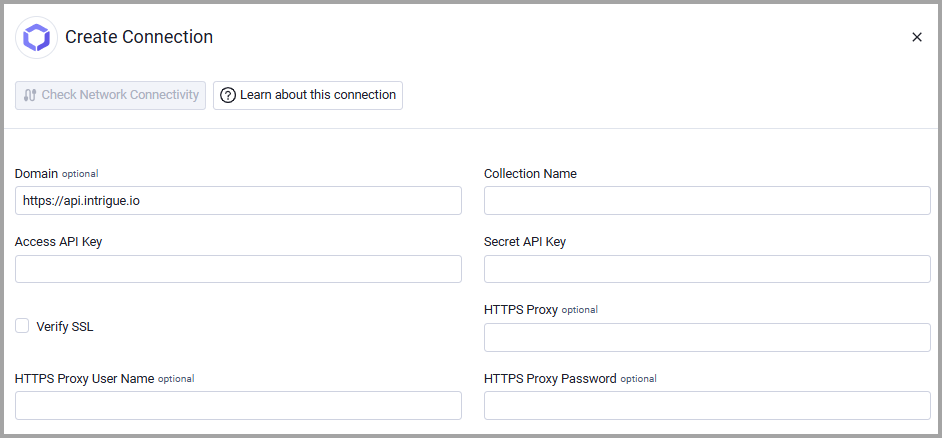
Optional Parameters
- Verify SSL (required, default: False) - Verify the SSL certificate offered by https://app.intrigue.io/. For more details, see SSL Trust & CA Settings.
- Domain - Override the default Intrigue domain. Use this setting to connect to a custom Intrigue instance or a different API endpoint. Default:
https://api.intrigue.io - HTTPS Proxy - Connect the adapter to a proxy instead of directly connecting it to the domain.
- HTTPS Proxy User Name - The user name to use when connecting to the value supplied in Domain via the value supplied in HTTPS Proxy.
- HTTPS Proxy Password - The password to use when connecting to the server using the HTTPS Proxy.
To learn more about common adapter connection parameters and buttons, see Adding a New Adapter Connection.
Updated 2 months ago
Did this page help you?