
VMware NSX Advanced Load Balancer
VMware NSX Advanced Load Balancer (formerly AVI Networks) delivers multi-cloud application services used for load balancing, web application firewall and container ingress.
Asset Types Fetched
- Devices, Load Balancers
Before You Begin
Ports
- TCP port 80/443
Authentication Method
- User Name/Password
APIs
Axonius uses the Avi Networks REST API Usage Version 22.1.1.
The API domain is local on client.
POST /login- Authenticate with the user name and password.GET /api/pool- Fetch pools. Also used to test the connection.GET /api/virtualservice- Fetch virtual services.GET /api/vsvip/{uuid}- Fetch the VIP addresses of a virtual service, using the VS VIP reference returned with the virtual service.GET /api/networkprofile- Fetch network profiles. Used when Fetch virtual service listeners (VIP ports, pool member ports and network profile protocols) is enabled.
Permissions
The value supplied in User Name must have ”Security-Readonly” Role permissions in order to fetch assets.
Supported From Version
Supported from Axonius version 4.6
Connecting the Adapter in Axonius
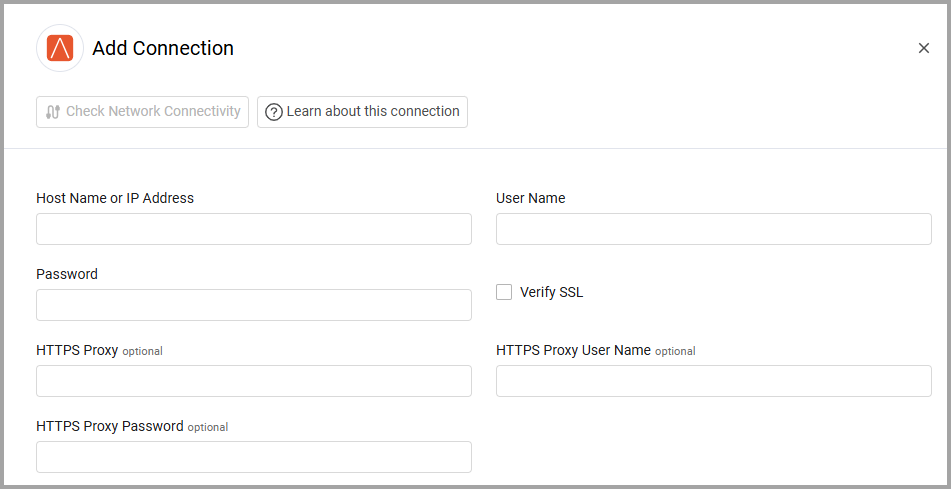
To connect the adapter in Axonius, provide the following parameters:
Required Parameters
- Host Name or IP Address - The hostname or IP address of the VMware NSX Advanced Load Balancer server.
- User Name and Password - The credentials for a user account that has the permissions to fetch assets. This needs to be for a local user account. Make sure you enable Basic Authentication in NSX ALB.
Optional Parameters
-
Verify SSL - Select whether to verify the SSL certificate of the server against the CA database inside of Axonius. For more details, see SSL Trust & CA Settings.
-
HTTPS Proxy - Connect the adapter to a proxy instead of directly connecting it to the domain.
-
HTTPS Proxy User Name - The user name to use when connecting to the value supplied in Host Name or IP Address via the value supplied in HTTPS Proxy.
-
HTTPS Proxy Password - The password to use when connecting to the server using the HTTPS Proxy.
To learn more about common adapter connection parameters and buttons, see Adding a New Adapter Connection.
Advanced Settings
Note
Advanced settings can either apply to all connections for this adapter, or to a specific connection. Refer to Advanced Configuration for Adapters.
- Parse devices as Load Balancers - Select this option to parse devices as load balancers.
- Fetch from all tenants - Select this option to fetch assets from all available tenants instead of the default tenant alone.
- Fetch virtual service listeners (VIP ports, pool member ports and network profile protocols) (default: disabled) - Select this option, together with Parse devices as Load Balancers, to collect the listeners of each virtual service. The adapter creates a listener for each virtual service port, with the VIP addresses and ports as ingress endpoints, the enabled pool members and their ports as egress endpoints, the TCP or UDP protocol from the network profile, and a Forward action to the pool. The adapter also records whether the virtual service is enabled. This setting sends one or more additional API requests for each fetch, to retrieve the network profiles.
Note
The VIP addresses of a virtual service are shown in Private IPs or Public IPs of the load balancer asset. Balanced IPs shows only the enabled pool members.
Note
To learn more about Adapter Configuration tab advanced settings, see Adapter Advanced Settings.
Version Matrix
This adapter was only tested with the versions marked as supported, but may work with other versions. Contact Axonius Support if you have a version that is not listed, which is not functioning as expected.
| Version | Supported | Notes |
|---|---|---|
| v1 | Yes | -- |
Updated 17 days ago