
IFS Assyst
IFS Assyst is IT service management (ITSM) software that helps automate business processes.
Use Cases the Adapter Solves
- CMDB Enrichment: Enrich the Axonius asset inventory with CMDB data from IFS Assyst to identify gaps between discovered assets and managed configuration items, improving asset coverage and accuracy.
- Application-to-Server Mapping: Fetch application-to-server relationships from IFS Assyst to map installed applications to their host devices, enabling software lifecycle management and license compliance tracking.
Types of Assets Fetched
This adapter fetches the following types of assets:
- Devices
- Software (configurable by Advanced Settings)
- SaaS Applications (configurable by Advanced Settings)
- Business Applications
Data Retrieved through the Adapter
Devices - fields such as: OS, Product Name, Status Name, Status ID
SaaS Applications - fields such as: Name, Business Owner, State, Application Type, Vendor
Before You Begin
Required Ports
- TCP port 443 (HTTPS)
Authentication Methods
IFS Assyst uses username and password authentication (HTTP Basic Auth) against the assystREST API.
APIs
Axonius uses the IFS Assyst REST API.
The following endpoints are called:
GET assystREST/v2/items— fetch Devices and SaaS ApplicationsGET assystREST/v2/itemRelations— fetch application-to-server relationships (when Fetch Application-to-Server Relations is enabled)
Required Permissions
The user account specified in the connection must have:
- Read access to the assystREST API
- Permission to query
itemsanditemRelationsresources
Supported From Version
Supported from Axonius version 4.8
Connecting the Adapter in Axonius
- Navigate to the Adapter Catalog, search for IFS Assyst, and select the adapter.
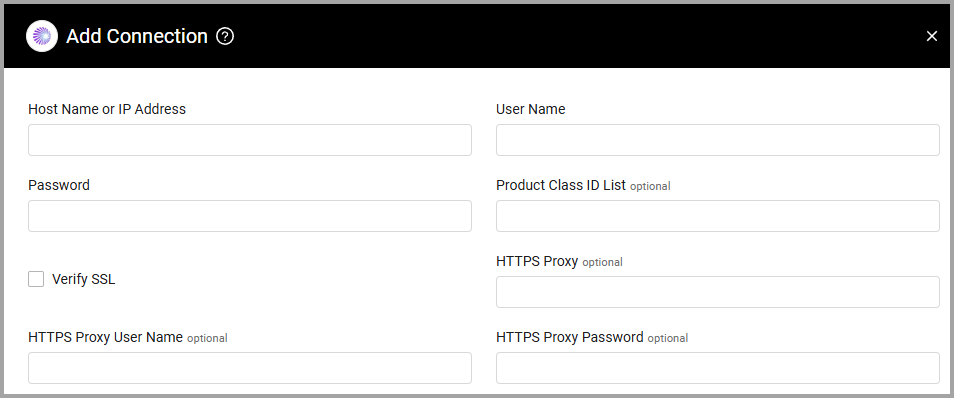
- Click Add Connection.
- Provide the following parameters.
Required Parameters
-
Host Name or IP Address (required) - The hostname or IP address of the IFS Assyst server.
-
User Name and Password (required) - The credentials for a user account that has the permissions to fetch assets.
-
Verify SSL - Select whether to verify the SSL certificate of the server against the CA database inside of Axonius. For more details, see SSL Trust & CA Settings.
Optional Parameters
-
Product Class ID List (optional) - Enter the Product Class ID to map to the product to import.
-
HTTPS Proxy (optional) - Connect the adapter to a proxy instead of directly connecting it to the domain.
-
HTTPS Proxy User Name (optional) - The user name to use when connecting to the value supplied in Host Name or IP Address via the value supplied in HTTPS Proxy.
-
HTTPS Proxy Password (optional) - The password to use when connecting to the server using the HTTPS Proxy.
To learn more about common adapter connection parameters and buttons, see Adding a New Adapter Connection.
Advanced Settings
Note
Advanced settings can either apply to all connections for this adapter, or to a specific connection. Refer to Advanced Configuration for Adapters.
-
UserField mapped to IP address (optional) - Enter a field name from Assyst to map to the Axonius IP address field. This field is case sensitive and must match what is seen in the Advanced View.
-
UserField mapped to MAC address (optional) - Enter a field name from Assyst to map to the Axonius MAC address field. This field is case sensitive and must match what is seen in the Advanced View.
-
UserField mapped to OS (optional) - Enter a field name from Assyst to map to the Axonius OS field. This field is case sensitive and must match what is seen in the Advanced View.
-
Parse Records with Status Name Starting with "App" as Business Applications (default: false) - Select to ingest records whose Status Name field begins with "App" as Discovered SaaS Application assets instead of Devices.
-
Fetch Application-to-Server Relations - Configure this group to fetch installed application relationships for each device from the
/itemRelationsendpoint. All of these settings must be configured in order for the feature to work.- Enabled (default: false) - Select to fetch installed application relations from
/itemRelationsand populate Installed Software on each device. - Entity Definition ID — Device (optional) - The numeric ID that identifies Device items in
/itemRelations. To find this value, navigate to IFS Assyst Administration > Entity Definitions and note the numeric ID for the Device entity type. - Entity Definition ID — Application (optional) - The numeric ID that identifies Application items in
/itemRelations. To find this value, navigate to IFS Assyst Administration > Entity Definitions and note the numeric ID for the Application entity type.
- Enabled (default: false) - Select to fetch installed application relations from
Note
To learn more about Adapter Configuration tab advanced settings, see Adapter Advanced Settings.
Related Enforcement Actions
Updated 2 days ago