
Red Hat Automation Controller (Ansible Tower)
Red Hat Automation Controller (Ansible Tower) is a web console and REST API for operationalizing Ansible across teams, organizations, and the entire enterprise.
Asset Types Fetched
This adapter fetches the following types of assets:
- Devices
- Software
- SaaS Applications
Data Retrieved through the Adapter
The following data can be fetched by the adapter:
- Devices - Fields such as: host name, IP addresses, MAC addresses, network interfaces, serial number
- Software - Installed software reported in the host facts.
Before You Begin
Required Ports
- TCP port 443 (HTTPS)
Authentication Methods
Axonius supports the following authentication methods:
- User name and password
- API Token
APIs
Axonius uses the Red Hat Ansible Tower API.
The adapter uses the following endpoints. The endpoint prefix is api/v2, or api/controller/v2 when Use API version 2.5+ prefix is enabled.
GET hosts/- Retrieves the list of hosts (paginated). Also used to test the connection.GET hosts/{id}/ansible_facts/- Retrieves the Ansible facts of each host.
Required Permissions
The following permissions are required:
- A user configured with a System Auditor user type, when connecting with User Name and Password.
- A user account that has permissions to fetch assets, when connecting with an API Token.
Connecting the Adapter in Axonius
- Navigate to the Adapter Catalog, search for Red Hat Automation Controller (Ansible Tower), and select the adapter.
- Click Add Connection.
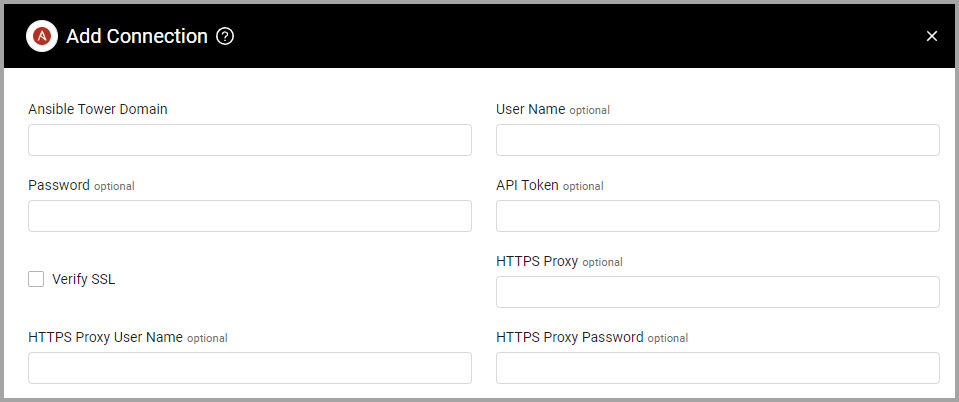
- Provide the following parameters.
Required Parameters
- Ansible Tower Domain - The hostname of the Red Hat Ansible Tower server.
- Verify SSL - Select to verify the SSL certificate offered by the value supplied in Ansible Tower Domain. For more details, see SSL Trust & CA Settings.
- User Name and Password - The user name and password for an Ansible Tower user configured with a System Auditor user type. For more details on Ansible Tower users, see Ansible Tower User Guide - Users.
- API Token - An API Token associated with a user account that has permissions to fetch assets.
Note
When API Token is not supplied, User Name and Password are required.
When User Name and Password are not supplied, API Token is required.
Optional Parameters
-
Use API version 2.5+ prefix - Select this option to enable the API (
/api/controller/v2/) for compatibility with newer platform versions, while maintaining backward compatibility with earlier versions. Enable this options if your Red Hat Ansible Automation Platform is version 2.5 or later. -
HTTPS Proxy - A proxy to use when connecting to the value supplied in Ansible Tower Domain.
-
HTTPS Proxy User Name - The user name to use when connecting to the value supplied in Ansible Tower Domain via the value supplied in HTTPS Proxy.
-
HTTPS Proxy Password - The password to use when connecting to the value supplied in Ansible Tower Domain via the value supplied in HTTPS Proxy.
To learn more about common adapter connection parameters and buttons, see Adding a New Adapter Connection.
Advanced Settings
Note
Advanced settings can either apply for all connections for this adapter, or you can set different advanced settings and/or different scheduling for a specific connection, refer to Advanced Configuration for Adapters.
- Switch hostname - Toggle on this option to use the value of another field as the hostname value. Available options are displayed.
- Parse hostname with description - Select this option to use the value of the Description field in the Host Name field if the description field exists. This option is only available when Switch hostname is enabled.
- Set Device ID to Name - Select this option to enable using the device name for the asset ID.
- Parse network device facts (default: disabled) - Select this option to parse the
ansible_net_*facts of network devices from the host facts that the adapter already fetches. The adapter retrieves the interfaces, CDP/LLDP neighbors, serial number, model, operating system, and hostname of network devices.
Note
To learn more about Adapter Configuration tab advanced settings, see Adapter Advanced Settings.
Related Enforcement Actions
Updated 12 days ago