
Cisco Catalyst Center (formerly Cisco DNA Center)
Cisco Catalyst Center is a software-based network automation and assurance solution.
Use Cases the Adapter Solves
- Network Device Inventory: Maintain a complete inventory of all network devices managed by Cisco Catalyst Center, including routers, switches, and wireless access points, with reachability status, software version, and site location.
- License Compliance Monitoring: Fetch per-device license compliance details and Smart Account pool usage metrics to identify expired or insufficient licenses across the network infrastructure.
Asset Types Fetched
- Devices, Aggregated Security Findings, SaaS Applications, Network Devices, Licenses
Data Retrieved through the Adapter
-
Devices - fields such as: Hostname, Management IP Address, MAC Address, Serial Number, Model
-
Network Devices (Wireless) - fields such as: AP Group, AP Ethernet MAC Address, SSID, Band,
-
Aggregated Security Findings - fields such as: Advisory details per device (when Fetch Advisories is enabled)
-
License Information (when Fetch Licenses is enabled) - fields such as: DNA Level, Network License, License Mode, Virtual Account Name
Before You Begin
Required Ports
- TCP port 443 (HTTPS)
Authentication Methods
Cisco Catalyst Center uses token-based authentication.
APIs
Axonius uses the Cisco Catalyst Center 2.3.7 API. The following endpoints are called:
POST dna/system/api/v1/auth/token- Authenticate and obtain an access tokenGET dna/intent/api/v1/network-device- Fetch network devicesGET dna/intent/api/v2/site- Fetch sitesGET dna/intent/api/v2/site/count- Get total site countGET dna/intent/api/v1/membership/{site_id}- Fetch site membershipGET dna/intent/api/v1/site-member/{site_id}/member- Fetch devices for a specific siteGET dna/intent/api/v1/floors/{floor_id}/planned-access-points- Fetch planned access points for a floorGET dna/intent/api/v1/data/reports- Fetch available reportsGET dna/intent/api/v1/data/reports/{report_id}/executions- Fetch report executionsGET dna/intent/api/v1/data/reports/{report_id}/executions/{execution_id}- Download report dataGET dna/intent/api/v1/security-advisory/device/{device_id}/advisory- Fetch security advisories per deviceGET dna/intent/api/v1/eox-status/device- Fetch End-of-Life (EoX) status per deviceGET dna/intent/api/v1/network-device/{device_id}/config- Fetch device running configurationGET dna/intent/api/v1/licenses/smartAccounts- Fetch Smart Accounts (when Fetch Licenses is enabled)GET dna/intent/api/v1/licenses/smartAccount/{smart_account_id}/virtualAccounts- Fetch Virtual Accounts per Smart Account (when Fetch Licenses is enabled)GET dna/intent/api/v1/licenses/usage/smartAccount/{smart_account_id}/virtualAccount/{virtual_account_name}- Fetch license pool usage metrics (when Fetch Licenses is enabled)GET dna/intent/api/v1/licenses/device/{device_uuid}/details- Fetch per-device license compliance details (when Fetch Licenses is enabled)
Required Permissions
The value supplied in User Name must have the Network Administrator role in Cisco Catalyst Center. This role provides the read access required to retrieve network device inventory, site topology, security advisories, EoX status, running configuration, and license data.
If the Network Administrator role is not available, ensure the user account has at minimum read access to the following:
- Network devices and device inventory
- Sites and site membership
- Security advisories (required for Fetch Advisories)
- Device running configuration (required for Fetch Device Running Configuration)
- License management — Smart Accounts and Virtual Accounts (required for Fetch Licenses)
- Reports (required for Client Detail and AI Endpoint Analytics report settings)
Note: If the account lacks permission to the EoX status endpoint, the adapter will log a warning but continue fetching all other device data.
Connecting the Adapter in Axonius
- Navigate to the Adapter Catalog, search for Cisco Catalyst Center, and select the adapter.
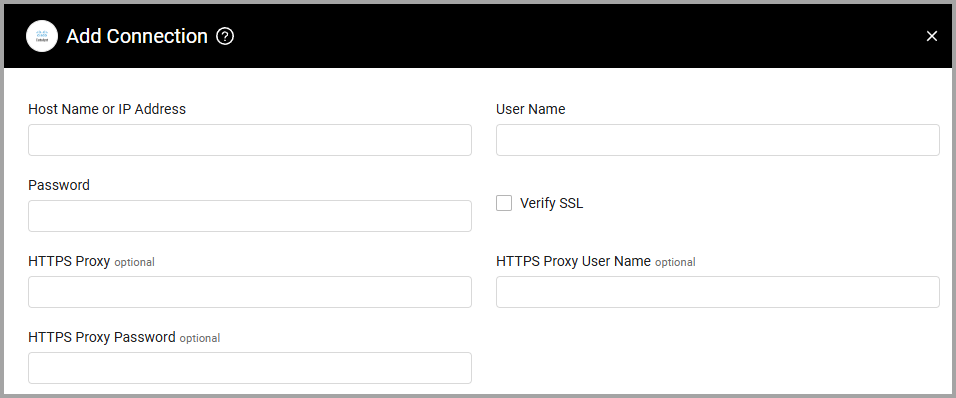
- Click Add Connection.
- Provide the following parameters.
Required Parameters
- Host Name or IP Address - The hostname or IP address of the Cisco Catalyst Center server.
- User Name and Password - The credentials for a user account that has the Required Permissions to fetch assets.
- Verify SSL - Select whether to verify the SSL certificate of the server against the CA database inside of Axonius. For more details, see SSL Trust & CA Settings.
Optional Parameters
- HTTPS Proxy - Connect the adapter to a proxy instead of directly connecting it to the domain.
- HTTPS Proxy User Name - The user name to use when connecting to the value supplied in Host Name or IP Address via the value supplied in HTTPS Proxy.
- HTTPS Proxy Password - The password to use when connecting to the server using the HTTPS Proxy.
To learn more about common adapter connection parameters and buttons, see Adding a New Adapter Connection.
Advanced Settings
Note
Advanced settings can either apply for all connections for this adapter, or you can set different advanced settings and/or different scheduling for a specific connection, refer to Advanced Configuration for Adapters.
- Get devices from the following "Client Detail" reports (optional) - Enter names of "Client Detail" reports required in order to fetch additional devices from configured “Client Detail” reports. Note that the reports must be in CSV format. If suitable reports are not found, additional details can be found in the fetch event logs.
- Report ID for Cisco AI Endpoint Analytics (optional) - Enter the Report ID necessary in order to download the report file and then parse network devices from it.
- Get devices per site location - Select this option to fetch devices via a method that includes the device site information.
- Fetch advisories per device - Select this option to fetch Cisco Catalyst advisories. These advisories contain information about vulnerabilities, and the data can be found under the vulnerable software for relevant devices.
- Fetch Network Maps for Network Devices - Select this option to enrich Device data with Network Maps, marking the locations of Network Devices.
- Fetch Device Running Configuration - Select this option to fetch Device Running Configuration and various configuration settings.
- Fetch Licenses - Select this option to fetch device-level license compliance details and Smart Account pool usage metrics.
- Fetch Tags - Select this option to fetch Cisco DNA tags associated with Network Devices. When enabled, tag names in the
Category: Valueformat are added as key-value tags, and tag names without that separator are added as key-only tags. - Fetch Network Segments (VLANs) - Select this option to fetch the VLAN interfaces of every switch as Network Segment assets. When enabled, the adapter makes two API calls per switch. The Network Segment assets include Interface Name and Full Site Name when the source provides those values. If Get devices per site location is disabled, the adapter also walks the site membership tree.
Note
To learn more about Adapter Configuration tab advanced settings, see Adapter Advanced Settings.
Updated 8 days ago