
Red Hat Satellite
Red Hat Satellite is a system management solution used to deploy, configure, and maintain systems across physical, virtual, and cloud environments.
Use Cases the Adapter Solves
- Software Inventory Visibility: Identify all installed packages and Red Hat subscription products across managed hosts, enabling accurate software inventory and license compliance tracking.
- Patch and Errata Management: Surface errata status and applicable package counts per host so that teams can prioritize patching for hosts with outstanding security or bug-fix advisories.
- Host Lifecycle Tracking: Track host check-in times, lifecycle environment assignments, content views, and organization membership to verify that all managed systems are actively reporting and correctly configured.
Types of Assets Fetched
This adapter fetches the following types of assets:
- Devices
- Aggregated Security Findings
- Software
- SaaS Applications
Data Retrieved through the Adapter
Devices - Fields such as Hostname, IP Address, MAC Address, Operating System
Before You Begin
Required Ports
- TCP port 443
Authentication Methods
Red Hat Satellite uses HTTP Basic Authentication.
APIs
Axonius uses the Red Hat Satellite API. The following endpoints are called:
GET /api/v2/hostsGET /api/v2/hosts/{name}GET /api/hosts/{id}/packagesGET /api/hosts/{id}/errataGET /api/v2/hosts/{name}/factsGET /katello/api/v2/host_collectionsGET /katello/api/v2/subscriptions
Required Permissions
The value supplied in User Name:
- Must be a local user. Only local users can have API access.
- Must have view_hosts permission.
- Must be assigned the proper organizations and locations.
- If you select
Fetch host facts, view_facts permission is required.
Setting Up Red Hat Satellite to Work with Axonius
- Log in to Red Hat Satellite as an administrator.
- Navigate to Administer > Roles.
- Click Create Role, enter a name (for example,
Axonius API Role), and click Submit. - On the role's page, click Add Filter. From the Resource Type list, select Host and enable the view_hosts permission. Click Submit.
- If you plan to enable Fetch host facts, add a second filter: select Fact Value as the resource type and enable the view_facts permission. Click Submit.
- Navigate to Administer > Users and click Create User.
- On the User tab, set Auth Source to INTERNAL (required for API access), then enter a username and password.
- On the Locations tab, assign the locations this user should have access to.
- On the Organizations tab, assign the organizations this user should have access to.
- On the Roles tab, assign the role you created in step 3.
- Click Submit.
Connecting the Adapter in Axonius
Navigate to the Adapters page, search for Red Hat Satellite, and click on the adapter tile.
Click Add Connection.
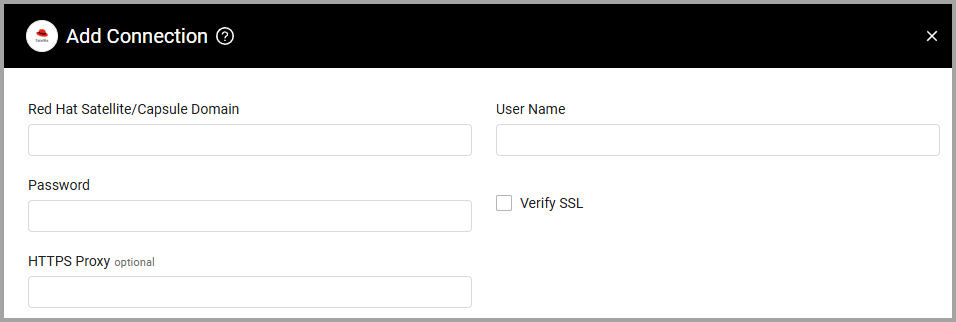
To connect the adapter in Axonius, provide the following parameters:
Required Parameters
- Red Hat Satellite/Capsule Domain - The hostname or IP address of the Red Hat Satellite server that Axonius can communicate with via the Required Ports.
- User Name and Password - The credentials for a user account that has Permissions to fetch assets.
Optional Parameters
- Verify SSL - Select whether to verify the SSL certificate offered by the value supplied in Red Hat Satellite/Capsule Domain. For more details, see SSL Trust & CA Settings.
- HTTPS Proxy - A proxy to use when connecting to the value supplied in Red Hat Satellite/Capsule Domain.
To learn more about the common adapter connection parameters and buttons, see Adding a New Adapter Connection.
Advanced Settings
Note
Advanced settings can either apply for all connections for this adapter, or you can set different advanced settings and/or different scheduling for a specific connection, refer to Advanced Configuration for Adapters.
-
Fetch host facts (required, default: true) - Select whether to fetch facts for every host.
-
Fetch host packages (required, default: true) - Select whether to fetch installed software for connected devices.
-
Fetch host errata - Select whether to fetch errata information (including vulnerable_software and Red Hat Errata information) for connected devices.
-
Host chunk size (required, default: 200) - The number of hosts returned every fetch.
-
Number of requests to perform in parallel (required, default: 50) - Set the number of requests to perform in parallel.
-
Fetch host subscriptions - Select whether to fetch the subscriptions fields from Red Hat Satellite.
-
Fetch host collections - Select whether to fetch the host collections fields from Red Hat Satellite.
-
Parse bridge interfaces as container interfaces - Select this option to parse the docker IP addresses into specific fields rather than the regular NICs.
-
Fetch host installed products (required, default: false) - Select whether to fetch installed products from the Red Hat Satellite subscription facet for connected devices.
-
Serial number source priority - Select which serial number type is parsed as the 'Device Manufacturer Serial': 'Chassis Serial (default)' or 'System Serial'.
Version Matrix
This adapter has only been tested with the versions marked as supported, but may work with other versions. Contact Axonius Support if you have a version that is not listed which is not functioning as expected.
| Version | Supported | Notes |
|---|---|---|
| Red Hat Satellite 6.6 and higher | Yes | API v2 |
| Red Hat Satellite 6.8 | Yes |
Updated 3 months ago