
Snow Software Asset Management - Send Software XML to SCP
Snow Software Asset Management - Send Software XML to SCP exports XML software data in Snow Software format for:
- Assets returned by the selected query or assets selected on the relevant asset page.
See Creating Enforcement Sets to learn more about adding Enforcement Actions to Enforcement Sets.
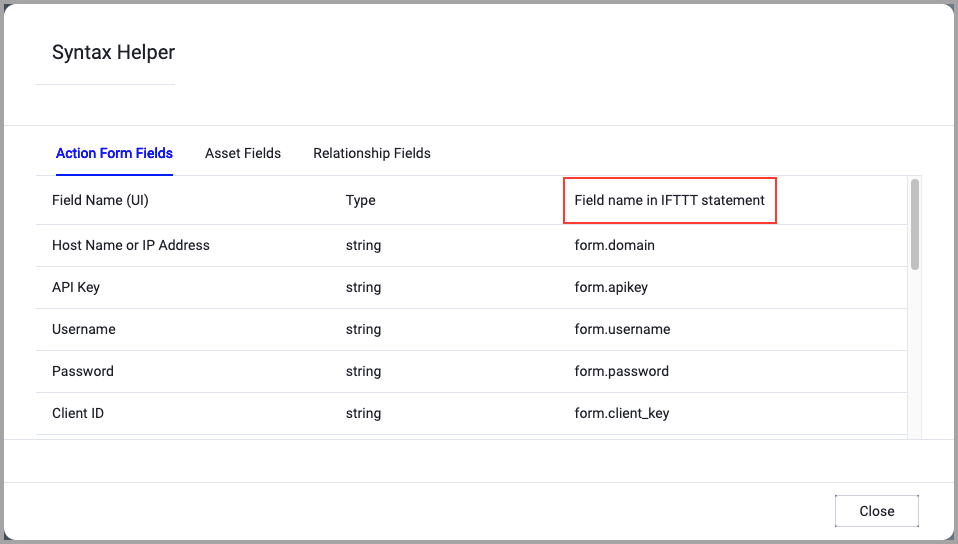
When accessing an enforcement action using the API, you must use the backend form of field names.
Use the Syntax Helper to find the correct name. In the enforcement action, enable Configure Dynamic Values and select Syntax Helper.
Note
- Not all asset types are supported for all Enforcement Actions.
- See Actions supported for Activity Logs, Adapters Fetch History, and Asset Investigation modules.
- See Actions supported for Aggregated Security Findings.
- See Actions supported for Software.
Required Fields
These fields must be configured to run the Enforcement Set.
- Action name - The name of this Enforcement Action. The system sets a default name. You can change the name.
- Configure Dynamic Values (optional) - Toggle on to enter a Dynamic Value statement. See Creating Enforcement Action Dynamic Value Statements to learn more about Dynamic Value statement syntax.
-
Hostname - The hostname or IP address of where to copy the Snow Software XML.
-
SSH port - Enter a value for the SSH port to use for the connection. Otherwise, Axonius uses the default port 22.
-
XML target path - Specify the full path on the SSH server, including the file name.
-
Install Date - Click the calendar icon to select the date that software data is to be exported back into Snow Software.
-
Compute Node - The Axonius node to use when connecting to the specified host. For more details, see Working with Axonius Compute Nodes.
Additional Fields
These fields are optional.
- User Name and Password - The credentials for a user account that has the Required Permissions to securely copy the XML.
- Private key - Click Upload File to choose and upload the Private key certificate file (in PEM format).
- Private key passphrase (default: empty) - Enter the password for the Private key file, if it is password-protected.
- Associated Device Username - Enter the name of the user associated with the device.
-
Gateway Name - Select the Gateway through which to connect to perform the action.
For more details about other enforcement actions available, see Action Library.
Updated 12 months ago