
Cisco Intersight
Cisco Intersight is a cloud operations platform that consists of optional, modular capabilities of infrastructure, workload optimization, and Kubernetes services.
Use Cases the Adapter Solves
- Data Center Infrastructure Visibility: Gain a unified view of physical and virtual compute assets managed through Cisco Intersight, enabling IT teams to track servers, chassis, and fabric interconnects across their data center environment.
- Hybrid Cloud Asset Inventory: Discover and inventory virtual machines, HyperFlex clusters, and VMware datastores managed via Cisco Intersight to maintain an accurate asset register across hybrid cloud environments.
Types of Assets Fetched
This adapter fetches the following types of assets:
-
Devices, Network Devices
Data Retrieved through the AdapterDevices: Fields such as Name, Hostname, Model, Serial Number
Network Devices: Fields such as Name, Model, Serial Number, Vendor
Before You BeginRequired Ports- TCP port 443 (HTTPS)
Authentication MethodsCisco Intersight uses HTTP Signature-based authentication. Each API request is signed using an API Key ID and a private key (RSA or ECC).
APIsAxonius uses the following APIs:
-
Cisco Intersight OpenAPI V3
The following endpoints are called: -
GET /api/v1/iaas/UcsdInfos -
GET /api/v1/compute/PhysicalSummaries -
GET /api/v1/server/Profiles -
GET /api/v1/virtualization/VmwareVirtualMachines -
GET /api/v1/hyperflex/Clusters -
GET /api/v1/view/Servers -
GET /api/v1/virtualization/VmwareDatastores -
GET /api/v1/equipment/Chasses -
GET /api/v1/fabric/Vsans -
GET /api/v1/equipment/SwitchCards
Required PermissionsThe following permissions are required:
Read-Only Role- Read access to compute resources (servers, physical summaries)
- Read access to virtualization resources (virtual machines, datastores, HyperFlex clusters)
- Read access to equipment resources (chassis, fabric interconnects, SAN switches)
- Read access to server profiles
Connecting the Adapter in Axonius
Navigate to the Adapters page, search for Cisco Intersight, and click on the adapter tile.
Click Add Connection.
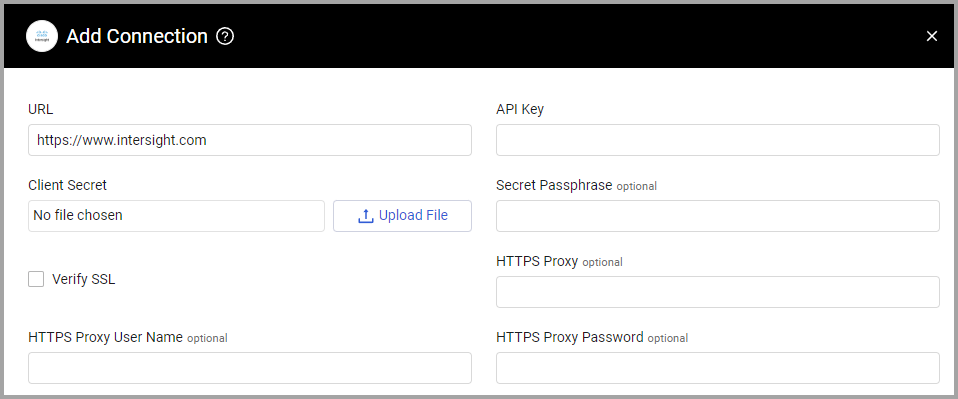
To connect the adapter in Axonius, provide the following parameters:
Required Parameters
-
URL - The hostname or IP address of the Cisco Intersight server. For North America, use
https://www.intersight.com. For EU, usehttps://eu-central-1.intersight.com. -
API Key - An API key ID generated using Cisco Intersight.
-
Client Secret - Select Upload File to upload a file with the credentials generated using Cisco Intersight.
Optional Parameters
-
Secret Passphrase - Specify a passphrase for the private key.
-
Verify SSL - Select whether to verify the SSL certificate of the server against the CA database inside of Axonius. For more details, see SSL Trust & CA Settings.
-
HTTPS Proxy - Connect the adapter to a proxy instead of directly connecting it to the domain.
-
HTTPS Proxy User Name - The user name to use when connecting to the value supplied in Host Name or IP Address via the value supplied in HTTPS Proxy.
-
HTTPS Proxy Password - The password to use when connecting to the server using the HTTPS Proxy.
To learn more about common adapter connection parameters and buttons, see Adding a New Adapter Connection.
Advanced Settings
Note
Advanced settings can either apply for all connections for this adapter, or you can set different advanced settings and/or different scheduling for a specific connection, refer to Advanced Configuration for Adapters.
- Fetch physical summaries - Select this option to fetch physical devices as assets.
- Fetch SAN switches as assets - Select this option to fetch SAN switches as assets.
- Override SAN switches name with MDS standard - Select this option to follow Cisco Intersight Dashboard naming logic and override the available name in the SAN Switch API response using the MDS prefix along with the Network Policy Name.
- Simple entity types to fetch- By default, all entity types are fetched. Use this setting to select which device entity types the adapter will fetch from Cisco Intersight.
Note
To learn more about Adapter Configuration tab advanced settings, see Adapter Advanced Settings.
Version Matrix
This adapter was only tested with the versions marked as supported, but may work with other versions. Contact Axonius Support if you have a version that is not listed, which is not functioning as expected.
| Version | Supported | Notes |
|---|---|---|
| Version 2 | Yes | -- |
Supported From Version
Supported from Axonius version 4.6
Updated 3 days ago