
System Deployment - Deploying the Virtual Appliance
The Axonius solution is installed as a virtual appliance in VMware ESXi, Amazon AWS, Microsoft Azure, and Google Cloud Platform and operated under a Shared Responsibility Model. Use this page to guide initial deployment decisions. Consult with Axonius Support for existing deployment sizing assistance.
Deployment Sizing Recommendations
Deployment Model
The standard Axonius deployment includes one virtual machine, scaled vertically. This is the only supported configuration without direct involvement from Axonius Support.
Recommended Self-hosted Deployments
| Deployment | Recommendation | Sizing |
|---|---|---|
| Self-hosted in the cloud (AWS, Azure, Google Cloud) | Recommended | We recommend this deployment method because you can easily scale the instance up or down if requirements change. Use the sizing tier as a starting point, and work with Axonius Support to refine the specification for your environment. |
| On-premises virtual host (VMware ESXi, Hyper-V, KVM, Nutanix) | Supported | Use the sizing tier as published. Additional recommendations include: ensure you are using equivalent CPU architecture; reserve memory and vCPU for the virtual machine and do not overcommit the host or rely on ballooning or swap; back the data disk with SSD or NVMe that meets the sizing tier's IOPS and throughput. |
These recommendations provide an initial target range, and are not a guarantee.
Sizing varies based on decisions you make including your retention periods, adapters, discovery frequency, and ingestion settings, so two environments with the same Devices & Users count can be drastically different in the data they hold. A data-rich deployment may need the next tier up, and a tier that fits at deployment may not be suitable in the future as these factors change. Where possible, deploy on an instance you can easily scale up or down. If you cannot, size larger than you estimate you will need. On-premises customers must monitor resources closely and should proactively enable telemetry. Contact Axonius Support or your Sales Engineer for the most accurate estimate.
Deployment Instance Specifications
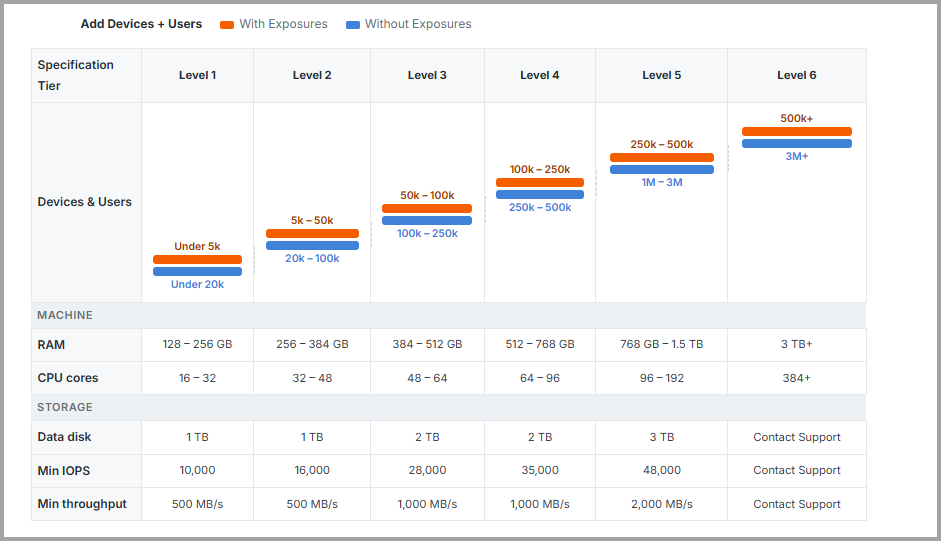
Add your estimated Device and User count and read across the top of the chart to find your tier. Whether Exposures is enabled changes the threshold, so read the matching colour.
Sizing Considerations
- Provision an instance with a modern generation CPU from a memory-optimized instance family that meets or exceeds the RAM and CPU cores listed above. Using older generation hardware/instances will lead to increased resource consumption.
- The data disk size shown for each tier is typical, and it grows or shrinks based on data ingestion and retention settings. You can extend the disk after deployment using standard Linux tools.
- If your environment has network segments that the Axonius appliance cannot reach directly, for example, isolated VLANs, air-gapped subnets, or remote sites, deploy an Axonius Gateway in each segment. The gateway is a lightweight agent that runs in the segment and relays adapter traffic back to the primary appliance; it does not store data. See Installing an Axonius Gateway for deployment and sizing details. Before deploying, also review the required network and firewall ports for both the appliance and any gateways.
Non-Standard Deployments
The configurations below fall outside the standard single-machine deployment. Engage Axonius Support before planning any of them.
Bare Metal
Bare metal deployments are not recommended and strongly discouraged. If bare metal is required, we recommend the following:
- Always consult Axonius Support when sizing a bare metal deployment.
- Add 75 – 200% to the sizing tier's RAM and data disk.
- Use NVMe storage.
- If you expect your Devices & Users count to grow after you deploy the machine, you may need to increase your instance specs in the future, which will require new hardware. In this scenario, we recommend starting at the upper end of the 75 – 200% range.
Compute Nodes
In some high-load configurations, Axonius Support may recommend adding a compute node, a secondary appliance that offloads adapter processing from the primary node. Compute nodes are not part of a standard deployment and should only be added at the direct recommendation of Axonius Support. See Working with Axonius Compute Nodes for details.
Central Core
Central Core is a multi-instance configuration in which a central Axonius instance aggregates data from other Axonius instances. It is not part of a standard deployment, and each instance is sized separately using the tiers above. Contact Axonius Support or your Sales Engineer to design a Central Core deployment for your environment.
Updated 44 minutes ago