
BeyondTrust BeyondInsight - Send Block Policy to SCP
BeyondTrust BeyondInsight - Send Block Policy to SCP sends a block policy, in XML format, for the software that results from the saved query supplied as a trigger (or assets that were selected in the asset table), and sends it to a specific path on an SSH server using SCP.
See Creating Enforcement Sets to learn more about adding Enforcement Actions to Enforcement Sets.
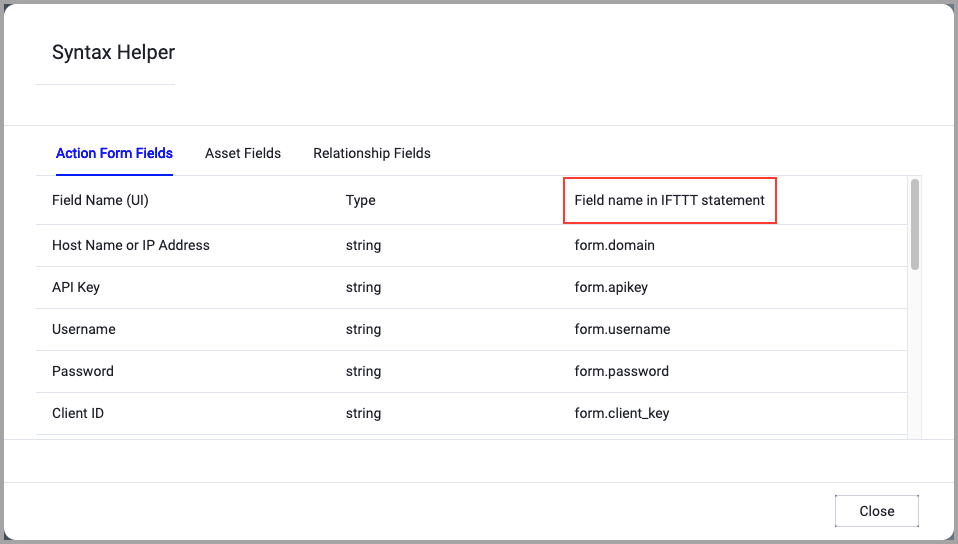
When accessing an enforcement action using the API, you must use the backend form of field names.
Use the Syntax Helper to find the correct name. In the enforcement action, enable Configure Dynamic Values and select Syntax Helper.
Note
- Not all asset types are supported for all Enforcement Actions.
- See Actions supported for Activity Logs, Adapters Fetch History, and Asset Investigation modules.
- See Actions supported for Aggregated Security Findings.
- See Actions supported for Software.
General Settings
- Action name - The name of this Enforcement Action. The system sets a default name. You can change the name.
- Configure Dynamic Values (optional) - Toggle on to enter a Dynamic Value statement. See Creating Enforcement Action Dynamic Value Statements to learn more about Dynamic Value statement syntax.
Required Fields
These fields must be configured to run the Enforcement Set.
- Hostname - DNS Address or IP of the SSH server.
- User name - The SSH user name to connect with.
- SSH port (default: 22) - The SSH port.
- XML target path (default: /home/policy.xml) - Specify the full path on the SSH server, including the file name.
-
Compute Node - The Axonius node to use when connecting to the specified host. For more details, see Working with Axonius Compute Nodes.
Additional Fields
These fields are optional:
NOTE
For authentication, you must specify at least Password or Private key, but you can also specify both.
-
Password - A password for the SSH user, if it exists. If specified, the password is used for authentication.
-
Private key - To use a private key for the SSH user, select a file and click Upload File.
-
Private key passphrase - Specify a private key passphrase if the private key is protected by a passphrase.
-
The following fields are section names in the XML that is created by the Enforcement Action. Enter a value for the relevant fields.
- Configuration ID
- Configuration Version
- Configuration Revision
- Configuration Revision Number
- GlobalOptionsSet ID
- Trusted Application Protection Version
- Trusted Application Protection Revision
- Application Group ID
- Application Group Name
- Application Type (default: exe)
An XML tag is created for each installed application.
-
Get installed software from CSV adapter only -
- When this option is enabled (the default), the XML file only includes software titles that are from the CSV adapter connection.
- When this option is disabled, the XML file includes software titles from the specified adapter connections.
-
Gateway Name - Select the Gateway through which to connect to perform the action.
For more details about other enforcement actions available, see Action Library.
Updated 12 months ago