
Axonius Threat Intelligence
Axonius Threat Intelligence enriches vulnerability data with additional exploit and threat context, helping you understand which CVEs are more likely to represent real-world risk. Instead of relying only on scanner severity or CVSS, you can see whether a vulnerability is known to be exploited, weaponized, trending, associated with threat actors, ransomware, botnets, or included in KEV sources. This gives your security teams better context for prioritization and helps them focus on vulnerabilities that are more likely to be actively used by attackers.
The data also improves investigation and decision-making by adding exploit timelines, references, affected CPEs, MITRE ATT&CK mappings, targeted industries/countries, and related threat activity directly into Axonius. As a result, your security teams can prioritize faster, reduce noise, and make more informed remediation decisions inside their existing exposure management workflows.
Notes
- This capability is available only for Exposures customers.
- Data received from Axonius Threat Intelligence is available on the Aggregated Security Findings page and on the Vulnerability Repository.
Field Mapping
Axonius Threat Intelligence retrieves and displays the following fields.
Note
Some fields are Complex Fields or Tables. See Asset Profile Page - Complex Fields for more information on table fields.
| Field Name | Description |
|---|---|
| In KEV | Whether the CVE is a Known Exploited Vulnerability |
| Vendor | The vendor or organization that owns the affected product |
| Product | The specific product affected by the vulnerability |
| Short Description | A brief summary of the vulnerability |
| Vulnerability Name | The common name assigned to the vulnerability |
| CISA Date Added | The date when CISA added the vulnerability to their KEV catalog |
| KEV Date Added | The date when Axonius first detected this vulnerability in the KEV catalog |
| Days Before CISA | The number of days between the Axonius detection and the addition to CISA, calculated as (CISA Date Added - KEV Date Added) in days (when both dates are present) |
| CWE ID | Common Weakness Enumeration identifiers associated with this vulnerability |
| Honeypot Detected | Whether Axonius detected exploitation attempts through the Honeypot network |
| Exploit References | Links to public exploit code repositories, converted from SSH clone URLs to HTTPS format |
| Citations | A complex field (table) that references to exploitation reports with source URL and date added fields Stores the following object fields: Source, Date Added |
| Public Exploit | Whether a publicly available exploit exists for this vulnerability |
| Weaponized Exploit Found | Whether a weaponized (ready-to-use) exploit was discovered |
| Exploit Maturity | The highest maturity level of available exploits (e.g., Proof of Concept, Functional, High) |
| First Weaponized Exploit | The date when the first weaponized or higher-maturity exploit was published |
| Exploits Count | Number of exploit instances associated with this CVE |
| Threat Actors Count | Number of threat actor groups associated with exploiting this CVE |
| Botnets Count | Number of botnet families associated with exploiting this CVE |
| Ransomware Families Count | Number of ransomware families associated with exploiting this CVE |
| Most Recent Exploitation | The most recent date of observed exploitation from Shadowserver or Honeypot sources |
| First Exploitation | The earliest date of observed exploitation |
| First Exploit Published | The date when the first exploit (on any maturity level) was published |
| Most Recent Exploit Published | The date when the most recent exploit was published |
| Associated Threat Actors | Names of threat actor groups known to exploit this CVE |
| Targeted Countries | Countries targeted by threat actors exploiting this vulnerability, aggregated across all associated actors |
| Targeted Industries | Industry sectors targeted by threat actors exploiting this vulnerability, aggregated across all associated actors |
| Botnets | Names of botnet families exploiting this CVE |
| Ransomware Families | Names of ransomware families exploiting this CVE |
| NVD Published | Whether the CVE has been officially published on NVD |
| CAPEC Mappings | A complex field (table) that displays common Attack Pattern Enumeration and Classification mappings that describe attack methods Stores the following object fields: CAPEC ID, Name, URL, Language |
| MITRE ATT&CK Techniques | A complex field (table) that displays MITRE ATT&CK framework techniques associated with exploiting this vulnerability Stores the following object fields: ID, Name, URL, Domain, Tactics, Sub-Techniques |
| MITRE ATT&CK Mitigations | A complex field (table) that displays recommended mitigations for each associated ATT&CK technique Stores the following object fields: ID, Technique ID, Mitigation URL, Description |
| MITRE ATT&CK Detections | A complex field (table) that displays detection methods for each associated ATT&CK technique Stores the following object fields: ID, Technique ID, Data Source, Data Components, Detects |
| MITRE D3FEND Mappings | MITRE D3FEND defensive countermeasure mappings for each associated ATT&CK technique |
| CVE ID | The unique Common Vulnerabilities and Exposures identifier (e.g., CVE-2024-1234). |
| CVE Description | Detailed description of the vulnerability and its potential impact |
| First Found Date | The date when this vulnerability was first discovered |
| Affected CPEs | Common Platform Enumeration identifiers specifying affected software/hardware configurations |
| CVE References | URLs to external references about the vulnerability, filtered for relevant exploit information |
| CVSS Version | The version of the CVSS scoring system used (e.g., 4.0, 3.1) |
| CVSS Vector | The complete CVSS vector string representing all scoring metrics |
| CVE Vector: Attack Vector | How the vulnerability can be exploited (Network, Adjacent, Local, Physical) |
| CVE Vector: Access Complexity | The complexity required to exploit the vulnerability |
| CVE Vector: Privileges Required | The level of privileges an attacker needs before exploitation |
| CVE Vector: User Interaction | Whether exploitation requires user action |
| Commercial Exploit Found | Whether commercial exploit tools or frameworks include this vulnerability |
| First Threat Actor Report Date | The earliest date when a threat actor was reported exploiting this CVE |
| Most Recent Threat Actor Report Date | The most recent date when a threat actor was reported exploiting this CVE |
| First Ransomware Report Date | The earliest date when ransomware was reported exploiting this CVE |
| Most Recent Ransomware Report Date | The most recent date when ransomware was reported exploiting this CVE |
| First Botnet Report Date | The earliest date when a botnet was reported exploiting this CVE |
| Most Recent Botnet Report Date | The most recent date when a botnet was reported exploiting this CVE |
| Trending on GitHub | Whether exploit-related repositories for this CVE are trending on GitHub. |
| Exploits | Detailed records of individual exploits |
| Threat Score | A composite score ranging from 0 to 10 for prioritizing a CVE based on real-world exploitation telemetry. It combines the Opportunity and Momentum scores (see below) with additional signals. Targeted attacks with increasing activity generally receive higher scores. |
| Opportunity Score | A score measuring how targeted the exploitation is, on a scale of 0 to 5. Low values indicate broad, opportunistic mass scanning; high values indicate deliberate targeting and victim selection. |
| Targeting Profile | A translation of the Opportunity Score field to a textual label:
|
| Momentum Score | A score Measuring how current exploitation volume compares with historical activity, on a scale of 0 to 5. Low values indicate declining or below-average activity; high values indicate rapidly growing or surging exploitation. |
| Exploitation Trend | A translation of the Momentum Score field to a textual label:
|
| Exploitation Phase | A complex field (table) that displays the current stage of the CVE's real-world exploitation lifecycle based on Axonius telemetry over time. Stores the following object fields: Label, Description |
| Score Adjustment | A complex field (table) that displays the corrections applied to the composite Threat Score. Stores the following object fields
|
| Attacker Countries | The geographic distribution of an observed attack traffic. Country keys use ISO 3166-1 alpha-2 codes. Note: This field reflects the geolocation of attacking infrastructure - not necessarily the attacker's nationality. |
| Attacker Objectives | The inferred goals of exploitation campaigns. Documented objectives include data exfiltration, infrastructure takeover, and ransomware. The objectives are inferred from observed attack patterns and post-exploitation behavior. |
| Events | A complex field (table) that lists key events in the CVE lifecycle, such as CVE publication, detection-rule release, first observed exploitation, and inclusion in CISA KEV. Stores the following object fields: Name, Date, Description, Sorting Priority |
| Exploitation Status | A CVE exploitation status ranking field including five severity-based categories. This field helps prioritize CVEs based on real-world exploitation evidence, not only CVSS or severity. Possible values and their logic:
|
Viewing Data
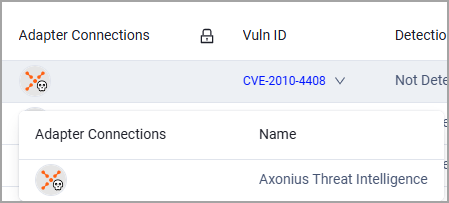
Data retrieved by Axonius Threat Intelligence is marked by a dedicated icon under the Adapter Connections column:
To add data from this source:
-
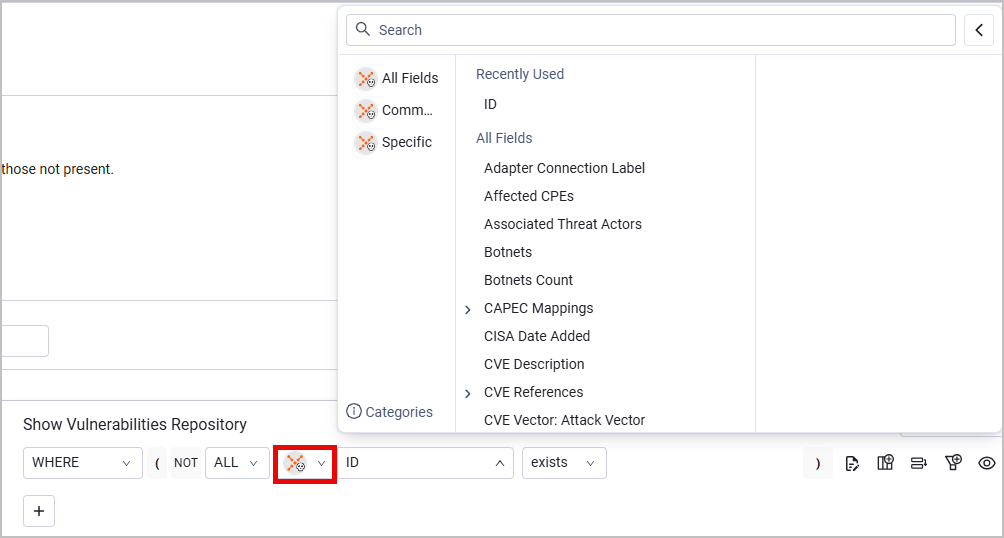
From the Aggregated Security Findings page or the Vulnerability Repository, click the Query Wizard.
-
Select Axonius Threat Intelligence from the Source dropdown.
-
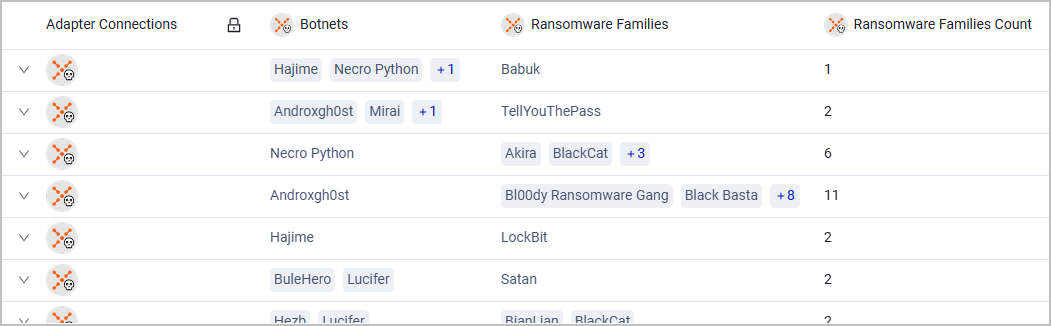
Select the required fields from the Field dropdown and apply any additional filters according to your needs. You can also add columns from Edit Columns > Edit Table.
Example data:
Select an asset from the table to explore it on its Profile page, then select Axonius Threat Intelligence under Adapter Connections to view the relevant data.
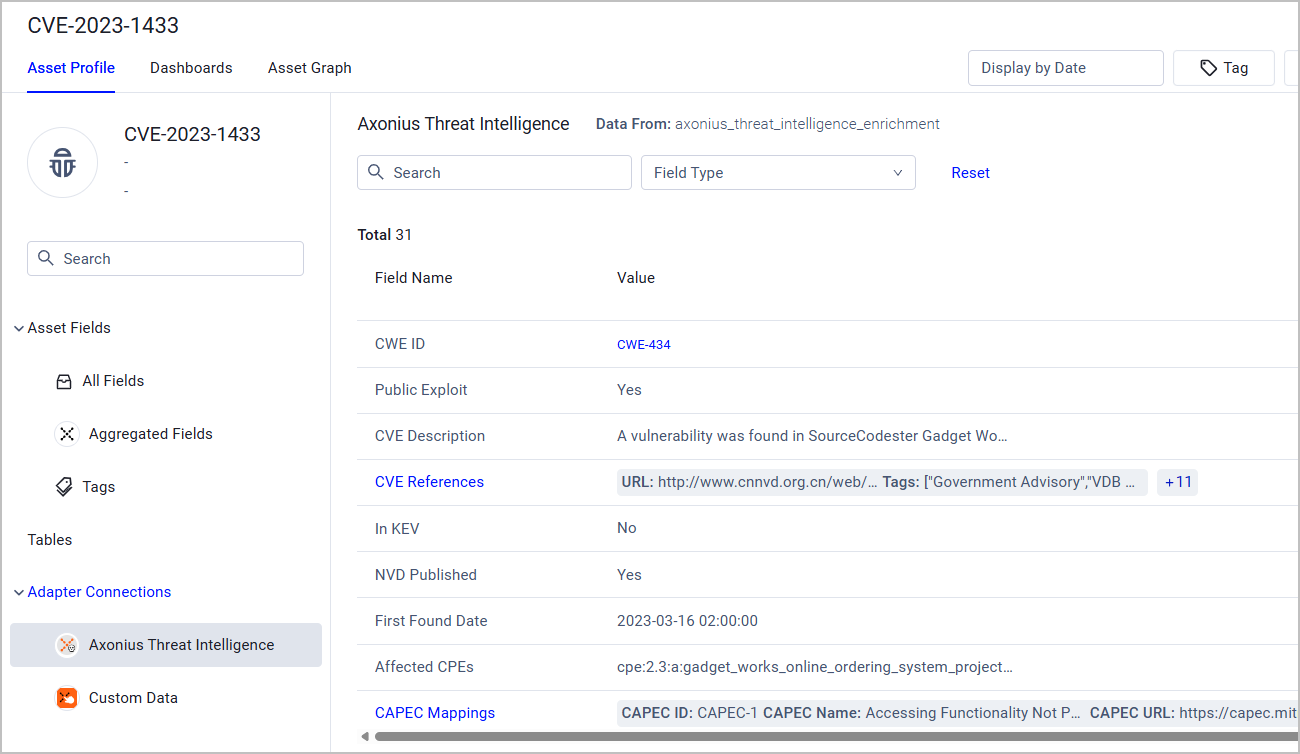
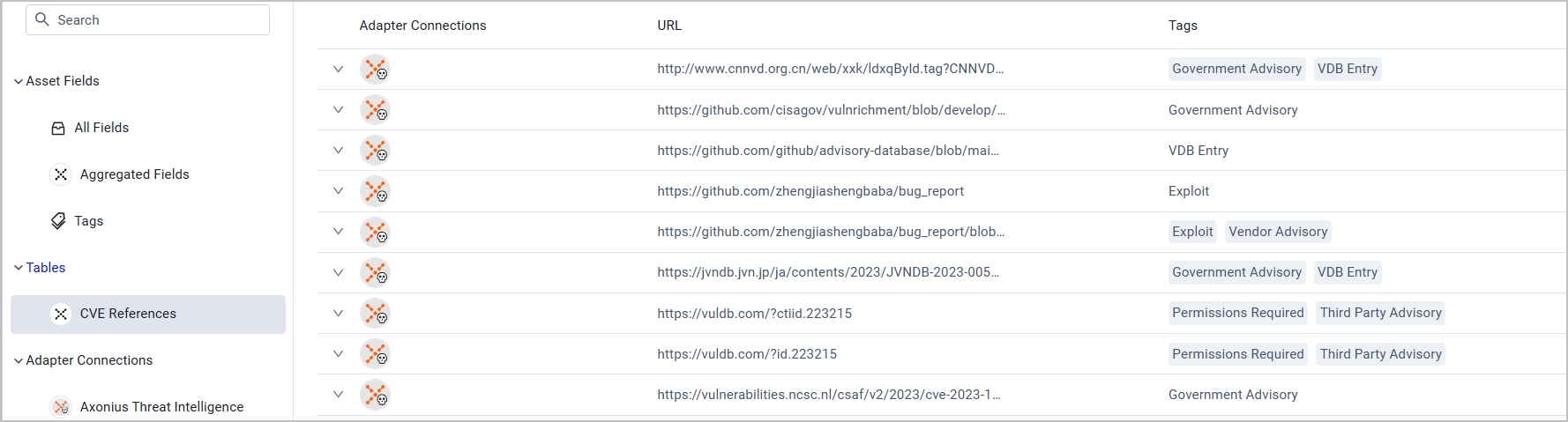
Clickable field names are tables and appear under the Asset Profile's Tables section. For example, see the CVE References table:
Updated about 2 months ago