
Men&Mice DNS Management
Men&Mice DNS Management is a Network Management platform providing secure, centralized, and resilient control of DNS across diverse platforms.
Use Cases the Adapter Solves
- DNS & DHCP Inventory: Discover all DNS zones, DNS servers, and DHCP servers managed by Men&Mice and correlate them with the devices in your Axonius asset inventory for a complete network infrastructure view.
- IP Address Management (IPAM) Visibility: Surface IPAM records alongside device data to identify IP allocations, detect unused or rogue addresses, and support network hygiene efforts.
Asset Types Fetched
Devices, Users
Data Retrieved through the Adapter
Devices - fields such as: Source (Devices, DNS Zones, DHCP Servers, DNS Servers), FQDN, DNS Zone ID, Subnet Location
Users - fields such as: Authentication Type, Roles, Group Roles, AD Distinguished Name
Before You Begin
Required Ports
- TCP port 443 (HTTPS) — default for the Men&Mice Web Service REST API. The exact port depends on your server configuration.
Authentication Methods
The Men&Mice DNS Management adapter supports two authentication methods:
- Basic Authentication (default) — Username and password. This is the default behavior when Use Session Authentication is not enabled.
- Session Authentication (optional) — Axonius sends a
POSTrequest to the Sessions endpoint with the username and password to obtain a session token, then usesAuthorization: Bearer {token}for all subsequent requests. Enable this when the Men&Mice server has Basic Authentication disabled.
APIs
Axonius uses the Men & Mice Web Service REST API. The following endpoints are called:
POST /mmws/api/Sessions— Authenticate and obtain a session token (used when Use Session Authentication is enabled)GET /mmws/api/Users— Fetch user accountsGET /mmws/api/Devices— Fetch managed devicesGET /mmws/api/DNSZones— Fetch DNS zonesGET /mmws/api/DNSZones/{zone}/DNSRecords— Fetch DNS records within a zone (used when Fetch DNS records is enabled)GET /mmws/api/DHCPServers— Fetch DHCP serversGET /mmws/api/dhcpScopes— Fetch DHCP scopes associated with DHCP serversGET /mmws/api/DNSServers— Fetch DNS serversGET /mmws/api/IPAMRecords/{address}— Fetch IPAM record for a specific IP address (used when Fetch IPAM Records is enabled)GET /mmws/api/Ranges— Fetch IP ranges (used for subnet enrichment)
Required Permissions
The user account provided in the connection parameters must have read access to the Men&Mice Web Service API. A dedicated read-only user is recommended.
Connecting the Adapter in Axonius
- Navigate to the Adapter Catalog, search for Men&Mice DNS Management, and select the adapter.
- Click Add Connection.
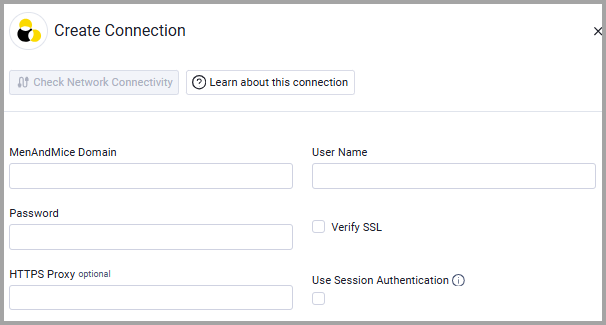
- Provide the following parameters.
Required Parameters
-
MenAndMice Domain - The hostname of the Men&Mice server.
-
User Name and Password - The user name and password for an account that has read access to the API.
-
Verify SSL - Select whether to verify the SSL certificate of the server against the CA database inside of Axonius. For more details, see SSL Trust & CA Settings.
-
Use Session Authentication (optional) - Select this option to use session-based authentication instead of Basic Authentication. Enable this when the Men&Mice server has Basic Authentication disabled. When enabled, Axonius authenticates using a session token obtained from the server's Sessions endpoint.
-
HTTPS Proxy (optional) - Connect the adapter to a proxy instead of directly connecting it to the domain.
To learn more about common adapter connection parameters and buttons, see Adding a New Adapter Connection.
Advanced Settings
Note
Advanced settings can either apply for all connections for this adapter, or you can set different advanced settings and/or different scheduling for a specific connection, refer to Advanced Configuration for Adapters.
-
Fetch devices - Fetches devices from the Devices endpoint.
-
Fetch DNS Zones as assets - Fetches devices from the DNSZones endpoint.
-
Fetch Users - Fetches users from the Users endpoint.
-
Fetch IPAM Records - Select this option to fetch IPAM Records as devices.
-
Fetch DHCP servers - check this to fetch DHCP servers as assets.
-
Fetch DNS servers - check this to fetch DNS servers as assets.
-
Fetch DNS records - check this to fetch DNS records as assets.
Note
To learn more about Adapter Configuration tab advanced settings, see Adapter Advanced Settings.
Related Enforcement Actions
Updated about 2 months ago